
09 Oct High Density Planting System in Cashew
1. Introduction
In our nation, cashews are a commercial crop that generates foreign income and are grown extensively in the states of Kerala, Maharashtra, Goa, Karnataka, Tamil Nadu, Andhra Pradesh, Orissa, the North Eastern provinces, and West Bengal. About 11.99 lakh hectares are used for cashew cultivation in our nation; from these, 7.94 lakh raw cashew nuts are produced, yielding a productivity of 674 kg per hectare (Anon., 2024). However, the level of productivity and production is extremely low. Productivity exceeds 2 tons/ha in other nations. We buy raw cashew nuts from other nations and have a processing industry in our nation that can process 15 to 20 ton of raw cashew nuts. To compensate for this, we need to increase production in India. Therefore, in the conventional system, the number of seedlings is low and one has to wait for 3 years for yield. The adoption of the dense planting system plays an important role in increasing production and productivity by planting more plants and obtaining faster yields. This article explains the information about the solid-state drive system in cashew.
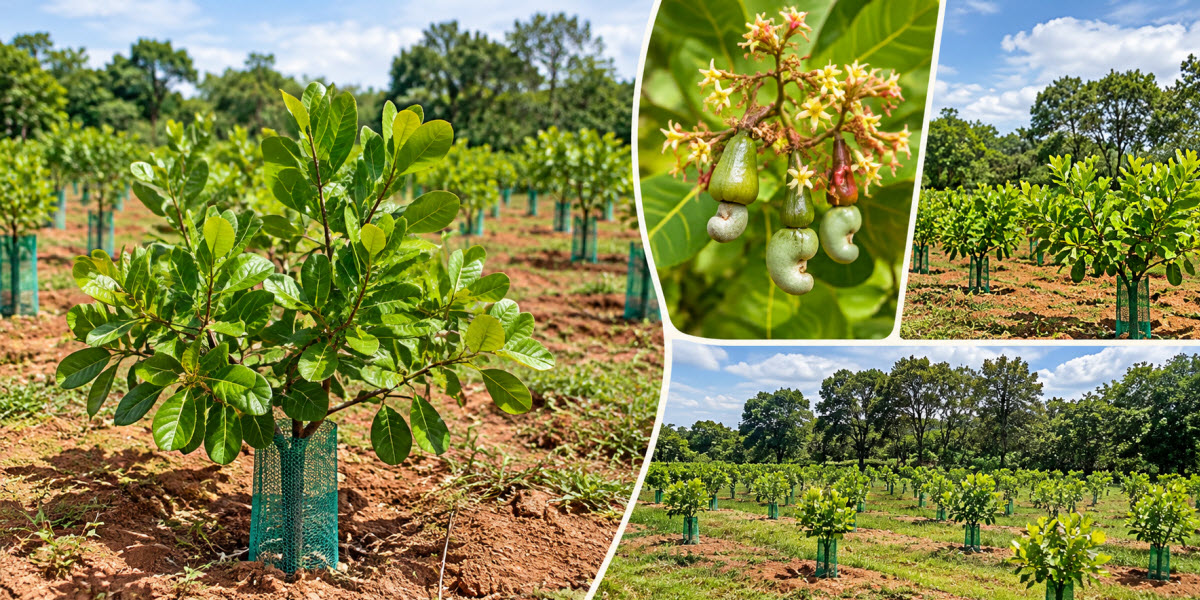
High Density Cashew planting is a technique that maximizes productivity per unit area, particularly in the early years, by planting cashew trees closer together than in traditional methods. There are 625 trees per hectare are planted with a 4 m × 4 m spacing for high-density planting. It is necessary to plant appropriate cashew varieties in order to obtain a satisfactory yield from this planting method. The term “HDP” is always linked to training and pruning procedures, which are used to regulate excessive vegetative development and the early framework of the plant. Particularly during the first ten years of plantation ownership, HDP yields more than traditional planting techniques. Not every variety can be used with HDP. Only the pruning-responsive, semi-vigorous, and precocious varieties are suitable for HDP.
2. Concept of HDP
- Maximum utilization of natural resources like solar radiation and Land.
- To increase the productivity and quality of the produce.
- To avoid congenial microclimate suitable for survival or breeding of pest and disease inoculum by proper pruning operation.
3. Selection of Site and Land Preparation
Cashews can be cultivated in every soil type, with the exception of black soil and areas that are flooded. Clear the area by getting rid of stubble, old trees, and stumps. If the land is flat, level it with a plow; if it slopes, create terracing across the slope. Two weeks before planting, the pits should be opened and exposed to sunlight to prevent termites, ants, and other insects. Digging a pit that measures 1 × 1 × 1 meters in length, width, and depth at a distance of 4 × 4 meters is advised. Add enough fertile soil to fill the pit two-thirds of the way. 5 kg of well-decomposed compost manure or chicken manure and 200 g of rock phosphate. Earlier they were following 5 × 5 m spacing, but as per the research experience, 4 m × 4 m is advantageous in the long run as compared to 5 m × 5 m.
4. Season, Method of Planting and Management
Grafts of particular cashew varieties should ideally be planted right in the center of the pit during the monsoon season, which runs from August to September. Planting can be done year-round if irrigation facilities are available. Life irrigation must begin immediately after planting. Staking is necessary for the graft to grow straight. Long-term moisture retention is possible with green manure mulching. Consequently, fewer irrigations will be required.
Irrigation can be applied to trees from January to March using either basin irrigation at fortnightly intervals of 200 liters per tree or drip irrigation at 4-day intervals of 60 to 80 liters per tree. To reduce seedling mortality from waterlogging, suitable drainage should be provided during the rainy season.
5. Varieties Suitable for HDP
Not every cashew variety is suitable for a high planting density. According to the results of our research, we have identified a few varieties that are suitable for high-density planting systems. They are Bidhan Bonsai Kaju from the AICRP center Nidhan Chandra Krishi Vishwavidyalaya, West Bengal; VRI-3 from Vridachalam, Tamil Nadu; and NRCC selection 2, Nethra Ganga, who was released from the ICAR-Directorate of Cashew Research, Puttur and other varieties. These types are semi-vigorous and very responsive to pruning, so we can give plants a good framework with heavy pruning, which will resulting in good cashew yields and flushes.
6. Training and Pruning
The cashew grafts are allowed to grow without side sprouts in the main stem up to 45–60 cm from the ground level to ensure a stronger trunk in later years. Regular shape pruning should be done to achieve an umbrella-shaped canopy with uniform spread. The growing tip should be pinched or nipped off to promote side branches or primary branches and subsequent secondary branches or laterals. Symmetrically, 3–4 primary branches are allowed in all 4 directions.
The flowering and fruiting may start in the first or second year, depending on the precocious bearing nature of cashew varieties. Pruning is a year-wise operation required to be carried out immediately after harvest (May–June). The recommended height of pruning during the 1st and subsequent years is 2 to 2.5 meters from the ground.
During the first 6th or 7th year, the crop canopy covers 100 percent of the allotted area. Pruning of branches is done to plants after the 6th or 7th year because, during this period, thick shade is formed due to overlapping of branches and turn to reduce yield.
After pruning, 10% Bordeaux mixture paste swabbing for large cut ends or 1% Bordeaux mixture spray for pruned shoots is recommended (Bhagya et al., 2024). As a preventive measure, pruned trees are to be sprayed with 0.06% lambda-cyhalothrin twice or thrice in the initial year of pruning. The tender shoots should be protected against attack by spraying with lambda-cyhalothrin 0.06% or thiamethoxam 0.02%.
7. Fertilizer and Manuring in HDP
Recommended fertilizer dosage for HDP is 160 g N: 80 g P2O5: 80 g K2O/plant/year for 5th year and above plantation. 10–15 kg well-decomposed FYM (Bhagya et al., 2025).
| Year of Planting | Urea | Rock Phosphate | Muriate of Potash |
|---|---|---|---|
| I year | 70 g | 80 g | 30 g |
| II year | 140 g | 160 g | 60 g |
| III year | 210 g | 240 g | 90 g |
| IV year | 280 g | 320 g | 120 g |
| V year and onwards | 350 g | 400 g | 150 g |
Fertilizers need to apply 50 cm, 75 cm and 100 cm away from trunk by opening circular trenches of 25 cm width and 15 cm depth during 1st, 2nd and 3rd year onwards, respectively and after application of fertilizer, it should thoroughly mixed with soil. Fertilizer should be applied during August–September month and we should avoid during heavy rain period to avoid the loss of fertilizer by leaching.
8. Plant Protection Measures
8.1 Pests
Though the cashew is infested with many pests, two major pests are bothering in cashew plantation they are Tea Mosquito Bug (TMB) and Cashew Stem and Root Borer (CSRB) (Aswathy et al., 2025).
8.1.1 Tea Mosquito Bug (TMB)
In general, TMB incidence commences during October to November coinciding with the emergence of new flushes after the monsoon. The population reaches a maximum during December to January when the plants are in full bloom and its activity is seen until harvest. The pest infests tender leaves, shoots, panicles, immature nuts as well as immature apples.
Symptoms: Initially water-soaked lesions appear at the feeding sites which turn scabby black in 2–3 days. Later, the lesion coalesces and ultimately results in drying of shoots and leaves. In the panicle it results in blossom blight where the flowers and stalks completely dried up. Upon severe damage most of the flushes and panicles dry up and the tree develops a scorched appearance.
Control measures: Spraying of Lambda cyhalothrin (0.6 ml/liter), Thiamethoxam (0.2 g/liter) and Acetamiprid (0.5 g/lit) whenever the incidence occurs at 5–10% damage.
8.1.2 Cashew Stem and Root Borer (CSRB)
In general, the pest incidence observed from December to May month.
Symptoms: At the base of the CSRB infested tree, gum and fibrous material are exuded in small quantities in the initial stage of attack. During later stage of attack, the infested tree canopies show a sickly appearance and the green leaves turn yellowish and start dropping prematurely. In the severe stages of attack, the twigs dry off and the bark on the trunk starts splitting. At this stage, large quantity of chewed fibers and gum (commonly known as frass) are seen as big lumps at the base of the CSRB infested tree.
Control Measure:
Cultural method
- Phytosanitation of the cashew plantations helps to reduce the pest population.
- The young plants should be trained to have branching at height of 0.6 m from the ground.
- Once the larva enters into the wood for pupation, it is difficult to locate. Hence, it has to be killed by inserting a gear wire/any bending metal wire.
Chemical method
- The pest stages have to be carefully removed by chiseling of the tunnels in the infested portion.
- The chiseled portion should be swabbed thoroughly with Fipronil 2 ml/lit and subsequently the tree base should also be drenched.
8.2 Disease Management
Diseases are not much bothered in cashew plantations and some recent emerging and important two diseases have been discussed here; they are Anthracnose and Gummosis.
8.2.1 Anthracnose
8.2.1.1 Symptom: Initially elongated dark brown to black water-soaked lesions on shoots later it will dry up and leaves which become crinkled, dry up and fall off. Small dark spots are formed on main stalk and lateral branches of the panicle, the flowers eventually wither and drop down and floral branches show drying symptom. Immature fruit turn black and fall prematurely. On mature fruit black irregular or roundish spots develop those are often sunken and gradually start rotting. The disease is more severe when rainfall coincidence with flowering season. Small black spots appear on nuts and apples and it becomes mummified.
8.2.1.2 Management:
- The anthracnose disease can be effectively managed by spraying plants and seedlings with the help of protective and curative fungicide.
- The affected plant parts should be pruned and burnt to prevent the spread of the disease.
- Spraying with 1% Bordeaux mixture or Mancozeb 0.25% or Copper oxychloride 0.3%.
- As infection of the fungus is usually preceded by infestation of tea mosquito bug, combined application of insecticide and fungicide is effective and more economical.
8.2.2 Gummosis
8.2.2.1 Symptom: Initially the symptom will exhibit as gum oozing from small cracks of the infested parts and reddish-brown liquid from the main stem and branches which later turns black in color giving tree bleeding appearance. The most diagnostic symptom is gum exudation followed by leaf yellowing and leaf drop. Longitudinal cracks also appear on the affected region from which gum exudes. The inner tissues of the affected portions turn reddish fluid and the affected branches dry gradually.
8.2.2.2 Management:
- Monitor the cashew plantations regularly and keep clean, prune the unproductive, dry and disease/insect infected branches.
- Chiseling out the affected plant portion and applying Bordeaux paste (10%).
8.3 Harvesting and Yield
Harvesting of fruits will be done by collecting of fallen fruits in the cashew plantation. In normal density planting cashew yield starts from 3rd year onwards and we can expect 0.5 kg/plant but in the high-density planting system we can expect yield from 1st or 2nd year itself with less than 1 kg. But in the 3rd year we can expect 2–3 kg yield. So, by this we can get more than 1 ton’s cashew nut yield per hectare.
Till 10th year HDP can be maintained with pruning and protective spray and 11th year onwards diagonal thinning need to be carried out for proper growth of canopy and 11th year onwards HDP will become normal density system and then it can be maintained as per the normal density cultivation practices. As per the earlier report from our directorate, it has been proved that 3 kg nuts/plant at 3rd year of planting even it is 2 kg also can bring 1.25 tones/hectare under HDP. This yield is superior over our national average yield of 674 kg/ha.
8.4 Conclusion
High Density Planting is advantageous with effective utilization of natural resources with 4-fold increase in yield till 6th year and 2–3-fold increase in yield up to 12th year under high density planting with 625 plants per hectare and 2–3-fold profit (Naik et al., 2011) can be obtained till 12th year as compared to normal density planting (156 plants/ha).
8.5 References
- Anonymous, 2024. https://dccd.gov.in/
- Naik, M.G., Bhat, P.S., Sajeev M.V., 2011, Cashew Production Technology. DCR Technical Bulletin 5. Published by M G Bhat, ICAR-Directorate of Cashew Research, Puttur. Pp.37-39.
- Bhagya H.P., Dinakar Adiga J., Shamsudheen M., Veena G.L., Thondaiman V., Babli Mog, Vanitha K, Manjesh G.N., Manjunatha K and Aswathy C, 2024, Canopy Management in Cashew Through Training and Pruning Technique. AgriGate: An International Multidisciplinary e-Magazine. 4(1): 24-33.
- Bhagya HP, Aswathy Chandra Kumar, Dinakara Adiga J, Eradasappa E, Babli Mog, Vanitha K, Veena GL, Manjesh GN, Thondaiman V, Siddanna Savadi Manjunatha K and Jyoti Nishad. 2025. Geru Beleyalli Ghana Sandra Paddati (High Density Planting in Cashew in Kannada). Extension Folder. Published by Director, ICAR-DCR, Puttur. Pp. 1-8.
- Aswathy Chandrakumar, Bhagya HP, Thondaiman V, Rajashekara H, Veena GL and Manjesh G N, June 2025. Good Agricultural Practices in Cashew- English folder. Published by Dr. J Dinakara Adiga, Director, ICAR-Directorate of Cashew Research, Puttur. Pp. 1-8.
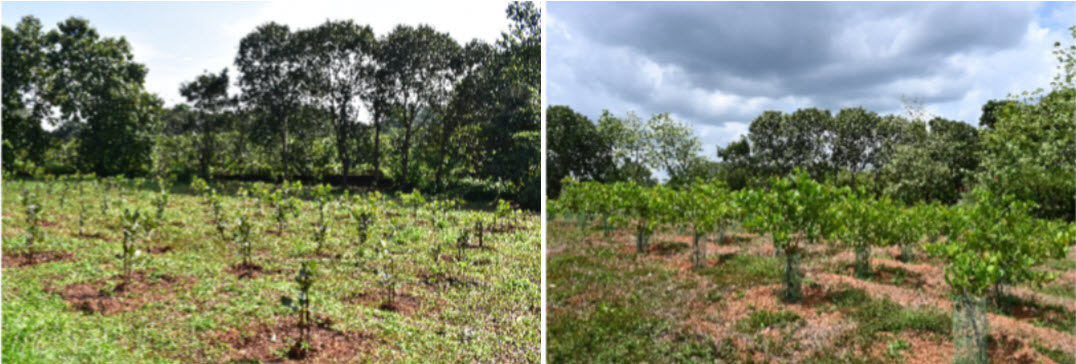
Fig. 1: Field view of High-Density Planting in Cashew
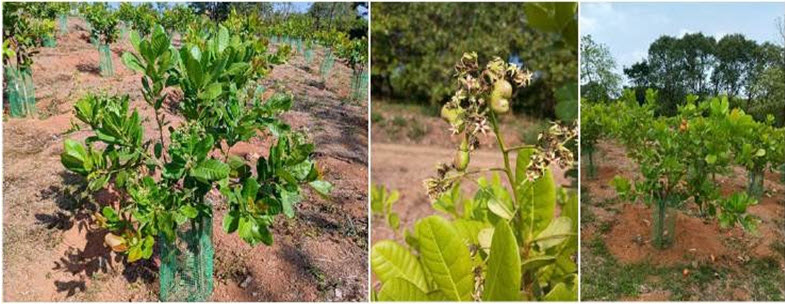
Fig. 2 Flowering and fruiting of one-year-old cashew plantation under high-density planting
Author
Bhagya H.P., Dinakara Adiga J., Eradasappa E., Thondaiman V., Siddanna Savadi, Manjunatha K., Babli Mog, Aswathy C. and Jyoti Nishad
ICAR-Directorate of Cashew Research, Puttur, Dakshina Kannada, Karnataka – 574202
Email: bhagya509@gmail.com
Related Posts