
Agriculture Knowledge for Everyone

Organic farming

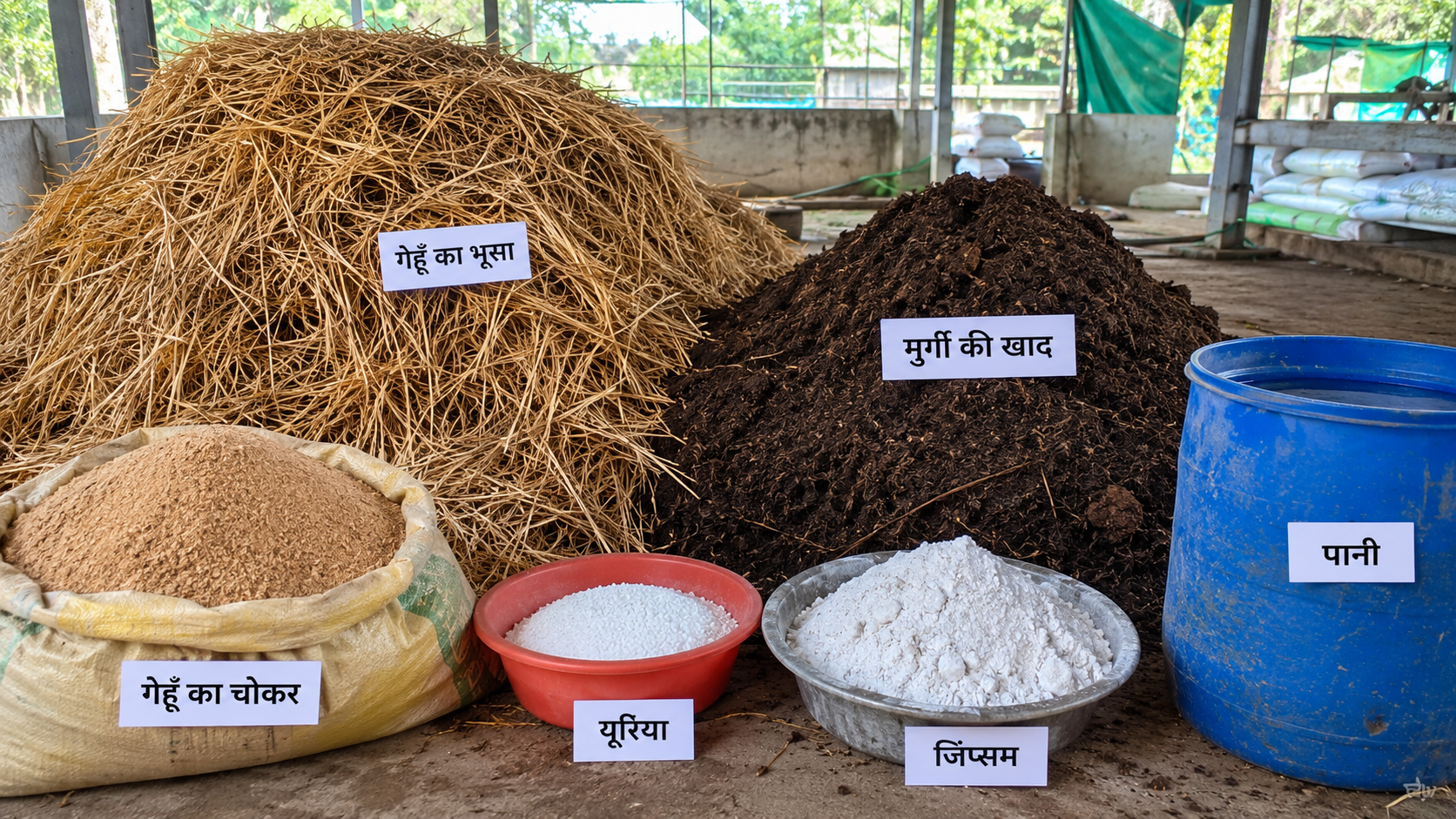
बटन मशरूम (Button Mushroom) की खेती में अच्छी पैदावार के लिए कम्पोस्ट की गुणवत्ता बहुत मायने रखती है। अगर कम्पोस्ट ठीक तरह से तैयार नहीं है, तो स्पॉन की ग्रोथ प्रभावित हो सकती है और आगे चलकर उत्पादन भी कम हो सकता है। अच्छा बटन मशरूम कम्पोस्ट बनाने के लिए गेहूं का भूसा, खाद, चोकर, नाइट्रोजन स्रोत, जिप्सम और पानी जैसे कच्चे माल का सही अनुपात जरूरी है। इसके साथ कम्पोस्ट की नमी, तापमान, हवा का आवागमन और समय-समय पर पलटाई पर भी ध्यान देना पड़ता है। बटन मशरूम कम्पोस्ट तैयार करने के लिए इस्तेमाल होने वाली प्रमुख सामग्री बटन मशरूम कम्पोस्ट बनाने के लिए जरूरी सामग्री कम्पोस्ट बनाने के लिए इस्तेमाल होने वाली सामग्री की मात्रा आपकी composting method और कच्चे माल की गुणवत्ता के अनुसार बदल सकती है। छोटे स्तर पर शुरुआत करने वाले किसान नीचे दी गई सामग्री को एक सामान्य आधार के रूप में देख सकते हैं। सामग्री सामान्य मात्रा भूमिका गेहूं का भूसा 100 kg कम्पोस्ट का मुख्य आधार मुर्गी की खाद 35–40 kg नाइट्रोजन और पोषक तत्व गेहूं का चोकर 5–10 kg अतिरिक्त पोषण यूरिया लगभग 1–1.5 kg नाइट्रोजन स्रोत जिप्सम लगभग 3–4 kg कम्पोस्ट की संरचना और aeration में मदद पानी आवश्यकतानुसार उचित नमी बनाए रखने के लिए ध्यान दें: ऊपर दी गई मात्रा एक सामान्य उदाहरण है। अलग-अलग composting systems में formulation अलग हो सकती है। व्यावसायिक उत्पादन के लिए स्थानीय कृषि विश्वविद्यालय, KVK या mushroom training centre...

Actinomycetes are widely recognized for significant role in promoting soil health and sustainable agriculture through the production of diverse bioactive compounds and plant growth promoting metabolites. This article highlights the ecological significance and agricultural importance of actinomycetes, with particular emphasis on their ability to produce antibiotics, extracellular enzymes, siderophores, and phytohormones. It also discusses their contributions to nutrient solubilization and mobilization, and enhancement of plant stress tolerance, biocontrol of pathogens and improvement of soil quality through bioremediation. Additionaly, the article explores the application of Actinomycetes as biofertilizers and bioinoculants in organic farming, emphasizing their potential to increase crop productivity while reducing dependence on chemical fertilizers and pesticides. Actinomycetes represent a promising and eco-friendly resource for improving soil fertility plant health, and the long-term sustainability of organic agriculture systems 1. Introduction to Actinomycetes Actinomycetes are Gram-positive, filamentous prokaryotic microorganisms belonging to the phylum Actinomycetota (Actinobacteria). Although they are classified as bacteria, they possess distinctive morphological and physiological characteristics that differentiate them from other bacterial groups. They are ubiquitous in terrestrial and aquatic ecosystems and are particularly abundant in soils with neutral to alkaline pH, high temperatures, or limited moisture availability, where they play a crucial role in maintaining soil health and ecological balance. Morphologically, actinomycetes exhibit a fungus-like growth pattern by producing extensively branched...

A goat produces approximately 1-1.5 kilograms of manure per day. A small farm of 50 goats can produce 1500-2250 kilograms of manure per month. Small farmers can prepare it themselves, further reducing costs. Given the growing demand for natural fertilizers in the current market, this is an attractive business option....

जैविक खेती में सूक्ष्मजीव नवाचार: रुझान और भविष्य की संभावनाएं Organic farming in India is growing rapidly, driven by global demand for sustainable agriculture and healthier food. This shift supports environmental conservation, biodiversity, and increasing consumer awareness of health benefits. As consumer demand for organic products increases and farmers recognize the long-term advantages of organic practices, the adoption of organic farming is anticipated to speed up. Microbial innovations are transforming organic farming by providing natural solutions for improving soil health, nutrient cycling, and pest/disease control, ultimately supporting sustainable and resilient agricultural. Organic Farming in India: Present and Future India's organic farming has deep roots in traditional sustainable practices. However, the Green Revolution popularized chemical inputs, boosting productivity but causing soil degradation and pollution. Growing awareness of these issues has led to a renewed interest in organic farming, focusing on natural inputs, biodiversity, and ecological balance. The Indian government has been promoting the organic farming practices through initiatives like the National project on organic farming (NPOF), Mission Organic Value Chain Development for North East Region (MOVCD) and   Paramparagat Krishi Vikas Yojana (PKVY). These programs encourage farmers to embrace sustainable practices and minimize dependence on chemical inputs. March 2025, India has 1.76 million hectares under organic farming, with 3.63 million hectares in the process of...

Bioponics: A Useful Technique for Eco-Friendly Food Production जलवायु परिवर्तन, गहन खेती के पर्यावरणीय प्रभाव, जनसंख्या वृद्धि और शहरीकरण जैसी वैश्विक चुनौतियों का समाधान करने के लिए, हमारी खाद्य प्रणाली धीरे-धीरे अधिक पर्यावरण-अनुकूल बन रही है। मिट्टी रहित कृषि की इस नवीन तकनीक में  मिट्टी के बिना खेती की जाती है और यह एक टिकाऊ खाद्य उत्पादन पद्दति भी है। बायोपोनिक्स में रासायनिक उर्वरकों के स्थान पर जैविक या प्राकृतिक वैकल्पिक उर्वरकों का उपयोग किया जाता है। ये पर्यावरण-अनुकूल उर्वरक पौधों या जानवरों के अपशिष्ट से बनता  हैं, जिन्हें बैक्टीरिया जैसे सूक्ष्मजीवों द्वारा संसाधित किया जाता है। परिणामस्वरूप, बायोपोनिक्स फलों और सब्जियों को उगाने में रासायनिक उर्वरकों पर निर्भरता को कम करता है, और  यह जल और भूमि संसाधनों के संरक्षण और आवश्यक पोषक तत्वों के पुनर्चक्रण का एक स्थायी तरीका भी  है। हमारी धरती, जलवायु परिवर्तन, बढ़ती वैश्विक जनसंख्या और शहरों की वृद्धि जैसे बड़ी चुनौतियों का सामना कर रही है। जैसे खाने की आवश्यकता वाले लोगों की संख्या लगातार बढ़ रही है, उसी प्रकार धरती पर ज्यादा शस्य उगाने का दबाव भी बढ़ रहा है। अधिक मात्रा में मिट्टी से पारंपरिक विधि में फल और सब्जियां उगाने से धरती को नुकसान पहुंचा सकती है। पारंपरिक कृषि में , मिट्टी में आवश्यक पोषक तत्व कम होता  है, कीटनाशकों जैसे हानिकारक रसायनों के...

जैविक खेती और दूध उत्पादन का एकीकरण: कृषि में अग्रणी स्थिरता In the vast and ever-evolving landscape of agriculture, a transformative approach is taking root—one that not only cultivates the land but nurtures the very essence of sustainability. It's the integration of organic farming principles with milk production, a harmonious synergy that not only sustains livelihoods but also preserves the delicate balance of our environment. Welcome to the dawn of a new era in farming—a sustainable approach that is revolutionizing the way we produce milk. What is organic farming? Organic farming, with its deep-rooted principles of harmony with nature, serves as the cornerstone of this transformative journey. It's not merely a set of practices; it's a philosophy—an ethos that reveres the interconnectedness of all living beings and ecosystems. At its heart lies the belief that by working in harmony with nature, we can cultivate abundance while safeguarding the very foundations of life. Integrated farming: Integrated organic farming is a holistic approach that emphasizes the integration of different farming practices to optimize resource utilization, minimize environmental impact, and enhance productivity. Unlike conventional farming methods that rely heavily on synthetic inputs such as chemical fertilizers and pesticides, integrated organic farming emphasizes natural processes, biodiversity, and ecological balance. At the core of integrated organic farming is soil health....

Natural farming is a necessity to maintain soil health and yield of sugarcane For sugarcane production, the field is deeply plowed two to three times, due to which a hard layer (hard pan) is formed on the lower surface of the field, which affects the air circulation, activity of microorganisms, etc. in the soil. In such a situation, if natural ingredients are used for sugarcane production, then the health of the soil will be maintained and the farmer brothers will continue to get bountiful yield. Natural farming is a necessity to maintain soil health and yield of sugarcane गन्ने की फसल में किसानों द्वारा अंधाधुन रसायनिक उर्वरक का इस्तेमाल किया जाता है जिससे मिट्टी की संरचना खराब होती है तथा धीरे-धीरे मिट्टी बंजर होने लगती है। गन्ना उत्पादन के लिए खेत की दो से तीन बार गहरी जुताई की जाती है जिससे खेत की निचली सतह पर कठोर परत (हार्ड पैन) बन जाता है जो कि मिट्टी में हवा संचरण, सूक्ष्मजीवों की क्रियाशीलता इत्यादि को प्रभावित करता है। ऐसी परिस्थिति में यदि गन्ना उत्पादन के लिए प्राकृतिक अवयव का प्रयोग करते हैं तो मिट्टी का स्वास्थ्य बना रहेगा और किसान भाइयों को भरपूर उपज मिलता रहेगा। पारंपरिक जैविक खादों की कमी के संदर्भ में मृदा संरक्षण और स्वास्थ्य पर बढ़ती चिंता के साथ, फसल...

Different types of organic pesticides and their importance in pest control agrochemicals are being used by the farmers for the purpose of reducing the outbreak of pests, diseases and weeds etc. on the crops. Use of these chemicals create disease tolerance and the natural enemies of insects  are affected. The residues of pesticides  pollutes agriculture produce , soil, water and air. To avoid the harmful effects of pesticide and for organic farming, it is absolutely necessary to use organic pesticides. Different types of organic pesticides and their importance in pest control देश में फसलों को कीटों, रोगों एवं खरपतवारों आदि से प्रतिवर्ष 7 से 25 प्रतिशत तक क्षति होती है। फसलों पर कीटों, रोगों एवं खरपतवारों आदि  प्रकोप को कम करने के उद्देश्य से कृषकों द्वारा कृषि रक्षा रसायनों का प्रयोग किया जा रहा है।  इन रसायनों का प्रयोग करने से जहाँ कीटों, रोगों एवं खरपतवारों में सहनशक्ति पैदा होती है और कीटों के प्राकृतिक शत्रु (मित्र कीट) प्रभावित होते हैं, वहीं कीटनाशकों का अवशेष खाद्य पदार्थों, मिट्टी, पानी, एवं वायु को प्रदूषित करने लगते हैं। कीटनाशक रसायनों के हानिकारक प्रभावों से बचने के लिए तथा जैविक खेती के लिए जैविक कीटनाशकों का प्रयोग करना नितान्त आवश्यक है।  विभिन्न प्रकार के जैविक कीटनाशक  1. नीम की पत्तियां एक एकड़  जमीन में छिड़काव के लिए 10-12 किलो...