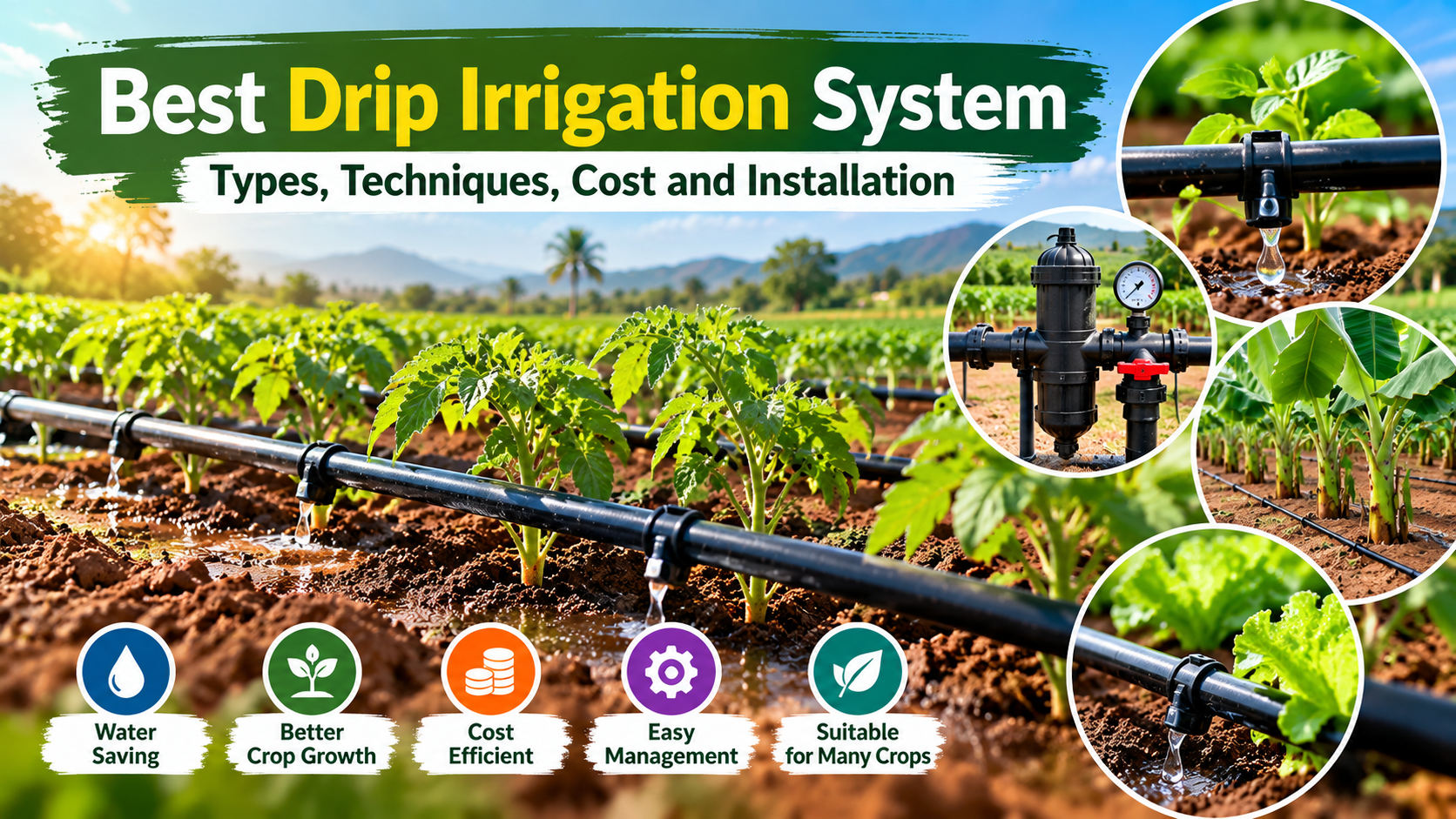
15 Oct Best Drip Irrigation System for Agriculture and Gardens: Types, Methods, Cost and Installation
Water management has become an important part of farming. In many areas, farmers cannot depend on regular rainfall throughout the growing season. They need an irrigation method that delivers water when crops need it, without wasting too much of the available supply. A drip irrigation system offers a practical way to manage this work.
Drip irrigation supplies water slowly near the roots of plants through a network of pipes and small outlets called drippers. Instead of wetting the entire field, water is directed towards the area where plants can use it. This method is used for vegetables, fruit orchards, plantation crops, nurseries and home gardens.
However, buying a drip system is not simply a matter of choosing pipes and connecting them to a pump. The crop, soil, water quality, plant spacing and field size all affect how the system should be designed. A setup that works well for tomato plants may not be suitable for a large mango orchard.
This guide explains the different types of drip irrigation, the best options for different crops, installation methods, operating costs, maintenance and common mistakes. It also includes a simple calculator to estimate water delivery and irrigation runtime.
What Is Drip Irrigation?
Drip irrigation is a method of watering crops in which small amounts of water are delivered directly to the soil around the plant roots. Water travels through pipes and comes out through specially designed outlets called drippers or emitters.
In traditional surface irrigation, water may flow through channels or spread over a large part of the field. Some water can run off, evaporate or move below the roots before the crop uses it. Drip irrigation gives the farmer greater control over where water is applied and how quickly it is delivered.
For example, a farmer growing chilli can install a lateral pipe along each crop row. The drippers release water near the plants, keeping the root zone moist without necessarily wetting the entire area between rows.
The goal is not to keep the soil continuously wet. Plants need both water and air around their roots. The right irrigation schedule maintains suitable moisture without creating waterlogging.
How Does a Drip Irrigation System Work?
The system starts with a water source such as a borewell, farm pond, storage tank or other suitable supply. Water passes through filtration equipment before entering the distribution network. The main pipeline carries water towards the field, while smaller pipes distribute it to individual crop rows.
Drippers release water at a controlled rate. Depending on the product, an emitter may deliver a specified number of litres per hour. The total water delivered depends on the number of emitters, their actual flow rate and the length of time the system operates.
Typical water flow:
Water Source → Pump, if required → Filter → Mainline → Sub-main → Lateral Pipe → Dripper → Plant Root Zone
The pump must supply sufficient flow and pressure for the selected irrigation zone. If the pressure is too low, plants at the end of a line may receive less water. If pressure is too high, leaks or uneven operation may occur when the equipment is not designed for those conditions.
Large farms are often divided into separate irrigation zones. This allows the farmer to operate different sections without demanding more water than the pump and pipelines can supply.
Types of Drip Irrigation Systems
Different drip irrigation arrangements are designed for different planting patterns. Understanding the main options makes it easier to choose equipment that fits the farm.
1. Surface Drip Irrigation
The lateral pipes are placed on top of the soil, usually beside crop rows. Water comes out through emitters positioned near the plants.
Suitable for: Tomato, chilli, brinjal, banana, grapes and many other crops.
Main advantage: Pipes and drippers are relatively easy to inspect and repair.
Limitation: Exposed pipes can be damaged by machinery, animals, sunlight or field operations.
2. Subsurface Drip Irrigation
The drip lines are buried below the soil surface, allowing water to enter the root zone from underneath the ground.
Suitable for: Selected field crops and planned long-term cropping systems.
Main advantage: Pipes are less exposed to surface damage, and surface evaporation may be reduced under suitable conditions.
Limitation: Installation, inspection and repairs require more planning.
3. Inline Drip Irrigation
Emitters are built into the lateral pipe at fixed intervals. This makes it convenient to distribute water along regularly planted crop rows.
Suitable for: Vegetables, nursery beds and selected row crops.
Important point: Choose emitter spacing according to the crop layout and soil wetting pattern.
4. Online Drip Irrigation
Separate drippers are fitted onto the lateral pipe wherever water is needed. Their positions can be adjusted to match plant spacing.
Suitable for: Mango, pomegranate, citrus and other widely spaced plants.
Important point: The number and discharge of drippers may need to change as plants grow.
5. Pressure-Compensating Drip
These emitters are designed to maintain relatively consistent discharge within their specified pressure range.
Suitable for: Some sloping fields and longer irrigation layouts where pressure variation needs to be managed.
Important point: Pressure-compensating emitters do not remove the need for correct pipe sizing and hydraulic design.
6. Garden Dripper System
Small drip kits supply water through narrow pipes and adjustable or fixed drippers. They are commonly used in home gardens.
Suitable for: Pots, terrace gardens, raised beds, flower plants and kitchen gardens.
Important point: Check the water pressure and make sure each plant receives an appropriate amount.
Which Type Is Best?
For a vegetable field with regular rows, inline drip irrigation may be a convenient choice. In an orchard, online drippers can provide greater flexibility because emitters can be placed around individual trees.
Subsurface drip irrigation may be useful in selected situations, but it should not be installed without considering soil conditions, filtration, root development and future maintenance. The best choice is the one that fits the crop and can be managed reliably.
Best Drip Irrigation System for Different Crops
Every crop has a different root system and water requirement. Plant spacing, soil type and the stage of growth also influence how water should be supplied.
| Crop | Possible Drip Arrangement | What to Consider |
|---|---|---|
| Tomato | Inline surface drip | Row spacing and soil wetting |
| Chilli | Inline drip | Root-zone moisture and crop spacing |
| Brinjal | Surface drip | Plant growth and emitter position |
| Banana | Surface drip with suitable emitters | Water demand as the plant grows |
| Pomegranate | Online or suitable surface drip | Root spread and tree age |
| Grapes | Surface drip | Vine spacing and seasonal water needs |
| Mango | Online drippers | Tree size and root distribution |
| Sugarcane | Designed row-crop drip system | Row layout and irrigation capacity |
| Cotton | Surface drip where appropriate | Plant spacing and field economics |
| Home garden | Garden dripper kit | Pot size and individual plant needs |
These are general starting points, not fixed engineering specifications. Emitter spacing, discharge rate and irrigation duration should be determined for the actual crop, soil and field layout.
Drip Irrigation for Vegetable Farming
Vegetables such as tomato, chilli, brinjal and cucumber can be grown with drip irrigation when the system is designed for the planting arrangement. Water should reach the active root zone without keeping the soil excessively wet.
During hot weather, crop water demand may increase. During rainy periods, irrigation may need to be reduced or stopped. Farmers should check soil moisture rather than operate the system for the same number of minutes every day.
Drip Irrigation for Fruit Orchards
Fruit trees have larger root systems than young vegetable plants. A small dripper positioned beside the trunk may not wet enough soil as a tree becomes established.
The number and placement of emitters should be adjusted according to tree age, canopy development, soil type and the area of active roots. Water should be distributed around the appropriate root zone rather than concentrated unnecessarily at one point.
Drip Irrigation for Home Gardens
A garden dripper system is useful for people who grow plants in pots, raised beds or small garden plots. It can reduce the time spent watering each plant individually.
Group plants with similar water requirements where possible. Pots dry out at different rates depending on their size, the growing medium, sunlight and wind exposure. Check them regularly, even when a timer is being used.
How to Choose a Drip Irrigation Brand
Farmers searching for Netafim drip irrigation or other branded systems should compare the complete installation rather than choosing solely by name.
Netafim is a recognised brand in the micro-irrigation industry. Its suitability for a particular farm depends on the product selected, crop requirements, installation design, water quality, service availability and overall cost.
The same approach applies when comparing Jain Irrigation or other established manufacturers and local suppliers. Different products are designed for different flow rates, pipe arrangements and operating conditions.
Questions to Ask Before Buying
- Is the system suitable for my crop and plant spacing?
- What emitter flow rate and spacing are recommended?
- What type of filter is required for my water source?
- Will the existing pump provide sufficient pressure and flow?
- Are spare parts and replacement drippers readily available?
- What does the warranty cover?
- Does the quotation include fittings, valves, installation and testing?
- Is technical support available if the system develops a problem?
A properly designed system with suitable filtration and dependable maintenance support is generally a better investment than equipment selected only because it is inexpensive.
Main Components of a Drip Irrigation System
1. Water Source
The source must provide enough water for the planned irrigation area. Check seasonal availability and water quality before deciding how much land the system can support.
2. Pump
A pump is required when the water source cannot provide the necessary pressure through gravity. Pump selection should account for the total flow demand, elevation changes and pressure losses through the pipes and filters.
3. Filter
Filtration removes particles that could block emitters. Screen, disc and media filters are used in different situations. The correct choice depends on the source water and the specifications of the drip equipment.
4. Mainline and Sub-Main Pipes
These pipes carry water from the source to different sections of the field. Their diameter and pressure rating should match the system design.
5. Lateral Pipes
Laterals are smaller pipes laid along the crop rows. They distribute water to individual drippers.
6. Drippers or Emitters
Drippers release water at a specified rate. Products may be rated at 2 litres per hour, 4 litres per hour or another flow rate. The right selection depends on crop needs, soil conditions and the planned irrigation duration.
7. Valves and Pressure Regulators
Valves allow farmers to control individual irrigation sections. Pressure regulators help maintain suitable operating pressure when required.
8. Fertigation Equipment
Suitable equipment can deliver compatible water-soluble fertilisers through the irrigation system. Fertigation needs proper nutrient planning, backflow protection and attention to fertiliser compatibility.
How to Install a Drip Irrigation System Step by Step
Step 1: Measure the Field
Record the field length and width, crop row spacing, distance between plants, slope and location of the water source. Mark paths, obstacles and areas where the elevation changes.
Step 2: Estimate the Water Requirement
Estimate the crop's water needs using the crop stage, local weather, soil type and field conditions. The number of plants and drippers helps determine the system's total flow requirement.
Step 3: Plan the Irrigation Zones
Large fields may need to be divided into smaller zones. This helps ensure the pump and pipes can deliver sufficient water without excessive pressure loss.
Step 4: Install the Filter and Mainline
Install filtration equipment before water enters the drip distribution network. Lay the mainline and sub-main pipes according to the planned layout.
Step 5: Lay the Laterals
Place lateral pipes beside the crop rows. For fruit trees, position the drippers according to the planned root-zone coverage and tree spacing.
Step 6: Connect the Emitters and Valves
Fit the required connectors, emitters, control valves and flushing arrangements. Make sure the components are compatible with the selected pipe sizes and pressure range.
Step 7: Flush and Test the System
Flush the lines according to the manufacturer's instructions. Run the system and inspect joints, valves and emitters. Check discharge at representative points near the beginning and end of the laterals.
Step 8: Set the Irrigation Schedule
Use crop water demand, soil moisture and actual emitter flow to determine operating time. Recheck the schedule when the weather changes or the crop enters a new growth stage.
Practical Drip Irrigation Techniques for Better Water Management
Understand the Soil Before Setting the Schedule
Water moves differently through different soils. Sandy soil generally allows water to move downward more quickly, while clay soil may allow slower infiltration and more sideways movement. Loamy soil behaves according to its texture and structure.
Because of these differences, the same irrigation duration may not work equally well in two fields. Check the wetting pattern around the drippers and adjust the schedule accordingly.
Check Moisture in the Root Zone
The soil surface can look dry even when sufficient moisture remains below it. Conversely, the surface may look wet while deeper roots receive insufficient water.
Check moisture within the active root zone. Soil moisture sensors or tensiometers can help with scheduling where they are available and properly used.
Change Irrigation as the Crop Grows
Young plants usually have smaller root systems than mature plants. As roots spread and the canopy grows, the amount and distribution of water may need to change.
Do not assume that a schedule prepared immediately after planting will remain correct for the entire season.
Avoid Excess Watering
Too much irrigation can reduce soil aeration, encourage root problems and move nutrients below the root zone. If water remains around plants for long periods, review the irrigation duration, emitter discharge and drainage.
Use Mulching Where Suitable
Suitable mulch can reduce evaporation from exposed soil and help manage weeds. The choice of mulch should match the crop, local climate, pest conditions and farming practices.
Inspect Drippers Regularly
A blocked emitter can leave one plant short of water even when the rest of the system is working. Inspect sample emitters and compare their discharge with the expected flow.
Apply Fertilisers Carefully
Fertigation can make nutrient application more convenient, but it should not replace proper nutrient planning. Use compatible fertilisers and follow crop-specific recommendations based on soil conditions and plant needs.
Adjust Irrigation After Rainfall
Rainfall can reduce the need for irrigation, particularly when enough water has entered the root zone. Check actual soil moisture before restarting the system after rain.
Drip Irrigation Water and Runtime Calculator
This calculator estimates how much water a drip system can deliver and how long it would take to apply a selected quantity of water per plant.
How to Understand the Result
The total system flow is calculated by multiplying the number of plants by the number of drippers per plant and the flow rate of each dripper.
The estimated runtime is calculated by dividing the planned water quantity for all plants by the total hourly flow rate.
This calculator is for estimating flow and runtime only. It does not determine the correct irrigation requirement for a crop. Actual discharge may vary with pressure, emitter condition and system layout. Choose irrigation duration based on field conditions and crop water needs.
Drip Irrigation System Cost in India
The cost of drip irrigation depends on the area to be covered and the equipment required. A small garden kit costs much less to install than a complete agricultural system with a pump, filtration unit and several irrigation zones.
The following items should be included when comparing quotations.
| Component | What Affects the Cost? |
|---|---|
| Drip lateral pipes | Length, diameter, material and emitter spacing |
| Mainline and sub-main pipes | Pipe dimensions, pressure rating and distance |
| Filter unit | Water quality, required flow and filter type |
| Pump | Flow demand, pressure, elevation and power requirements |
| Emitters and fittings | Number of plants, system design and component type |
| Valves and regulators | Number of zones and pressure-control requirements |
| Automation | Timers, sensors, controllers and electrically operated valves |
| Installation and labour | Field layout, site conditions and work required |
How to Avoid Unnecessary Installation Costs
- Measure the field before ordering pipes.
- Obtain a layout based on the actual crop spacing.
- Compare itemised quotations rather than only the final price.
- Check that the quotation includes filters and necessary fittings.
- Consider maintenance costs and spare-part availability.
- Avoid buying equipment that is not required for your field.
Request current quotations from suppliers serving your area. Without the field dimensions, crop, water source and required equipment, a single price estimate may be misleading.
Government Assistance for Drip Irrigation
Financial assistance for micro-irrigation may be available to eligible farmers under applicable government programmes. The amount of assistance and the application process can vary by state, farmer category, crop, landholding and programme rules.
Farmers should check the current requirements with their local agriculture or horticulture department before buying equipment. Ask whether prior approval, an authorised supplier, a field inspection or specific documents are required.
Keep copies of the quotation, land records, identity documents, bank details and other paperwork requested by the relevant authority. Do not assume that every installation or purchase will qualify for assistance.
Advantages of Drip Irrigation
More Control Over Water Application
Water can be delivered close to plant roots in controlled amounts. This helps farmers manage irrigation according to crop needs rather than wetting the entire field.
Less Wetting Between Crop Rows
When water is concentrated near the crop, some areas between rows may remain drier. This can help reduce weed growth in those areas, although it does not eliminate weeds.
Convenient Fertiliser Application
Compatible water-soluble fertilisers can be supplied through a properly designed fertigation system. This allows nutrients to be applied in planned quantities.
Reduced Manual Watering
Once the system is installed and adjusted, it can reduce the time required to water plants manually. Timers and automation may make irrigation management easier.
Suitable for Many Crops
Drip irrigation can be used for vegetables, fruit orchards, selected field crops, nurseries and home gardens. The layout needs to match the crop and site conditions.
Limitations of Drip Irrigation
- The initial installation cost may be higher than basic surface irrigation.
- Drippers may become blocked if filtration and maintenance are inadequate.
- Water quality can affect equipment performance.
- Incorrect pipe sizing can cause uneven water delivery.
- Exposed pipes can be damaged during farming operations.
- Subsurface systems may be difficult to inspect and repair.
- Pumps, filters and other components may require periodic maintenance.
These limitations can be managed through suitable design, correct installation, regular inspection and timely repairs.
Drip Irrigation Maintenance and Troubleshooting
Regular maintenance keeps the system operating as intended. A pump may be running while some emitters remain blocked, so checking the system visually is not enough.
Clean the Filter
Inspect and clean the filter according to its design and the manufacturer's instructions. A dirty filter can restrict water flow and affect irrigation pressure.
Flush the Pipes
Use the provided flushing arrangements according to the system's maintenance procedure. Flushing helps remove accumulated particles from the pipes.
Check Emitter Discharge
Inspect representative emitters at different points along the lateral lines. Compare their discharge to identify blockages or pressure-related differences.
Look for Leaks
Damaged pipes, loose connectors and leaking valves can waste water and affect pressure. Repair leaks promptly using compatible fittings.
Review the Irrigation Schedule
Check whether the soil is becoming too dry or remaining excessively wet. Change the schedule according to the crop's needs, weather and soil conditions.
| Problem | Possible Reason | What to Check |
|---|---|---|
| Dripper not releasing water | Blockage or low pressure | Filter, pressure and emitter |
| Uneven watering | Pressure loss or unsuitable pipe layout | Flow at different points |
| Repeated blockages | Particles or mineral deposits | Water quality and filtration |
| Water collecting around plants | Excess irrigation or poor drainage | Runtime and soil condition |
| Leaking connections | Damage or loose fittings | Pipe joints and connectors |
| Plants wilting despite irrigation | Insufficient root-zone moisture or another crop problem | Emitter output, roots and soil |
Do not use acids or other cleaning chemicals without confirming that the treatment is suitable for the equipment and water quality. Incorrect chemical use can damage components and create safety risks.
Common Drip Irrigation Mistakes Farmers Should Avoid
Choosing Emitters Without Checking the Soil
Different soils distribute water differently. Selecting an emitter only by its flow rate may result in an unsuitable wetting pattern.
Ignoring Pressure Requirements
The pump, filter, valves and pipes must work together. An unsuitable layout may leave the end of the field with insufficient pressure.
Using the Same Schedule Throughout the Season
Crop water requirements change with growth, temperature, wind and rainfall. Check the soil and adjust the schedule when conditions change.
Installing a System Without Filtration
Small particles can block emitters and reduce water delivery. Choose filtration according to water quality and equipment specifications.
Overwatering Because the Surface Looks Dry
The soil surface may dry while moisture remains deeper in the root zone. Check the soil before extending irrigation time.
Ignoring Small Problems
A minor leak or blocked dripper can become a larger problem if it remains unnoticed. Routine inspection helps identify issues early.
Comparing Only the Purchase Price
A system's long-term value depends on its suitability, reliability, service support and maintenance needs. Compare the complete installation before deciding.
How to Check Whether Your Drip Irrigation System Is Working Properly
A practical way to check system performance is to observe several emitters across the field rather than inspecting only one plant.
- Select representative emitters near the start, middle and end of several lateral lines.
- Collect their water output for the same measured period using suitable containers.
- Compare the collected quantities.
- Investigate significant differences by checking pressure, blockages, leaks and pipe layout.
- Repeat the check after repairs or major maintenance.
For a more formal assessment, an irrigation technician can measure discharge uniformity and pressure throughout the system. The correct procedure depends on the system design and equipment specifications.
Frequently Asked Questions About Drip Irrigation
Which is the best drip irrigation system for agriculture?
The best system depends on the crop, soil, water source, field size and budget. Inline drip can suit regularly planted rows, while online drippers can offer flexibility for fruit trees. The final layout should be based on actual field requirements.
Is Netafim drip irrigation a good option?
Netafim is an established micro-irrigation brand. Compare the relevant product specifications, filtration requirements, warranty, service support and total installation cost before purchasing.
What is a garden dripper system?
A garden dripper system is a small network of pipes and emitters that supplies water to pots, flower beds, raised beds and other garden plants. Some kits also include timers and adjustable drippers.
How much water does drip irrigation use per hour?
The amount depends on the number of working emitters and their actual discharge. For example, 100 emitters delivering 2 litres per hour each would supply 200 litres per hour under those operating conditions.
How many drippers are needed for one plant?
The number depends on plant size, root spread, soil type, emitter discharge and the required wetting area. Some plants may need one emitter when young and additional emitters as they grow.
Can drip irrigation work without electricity?
A small system may operate using gravity if the water source provides sufficient pressure and elevation. Larger installations often require a pump or another suitable pressure source.
Can drip irrigation be used for sugarcane?
Yes, drip irrigation can be used for sugarcane when the system layout, crop spacing, water supply and economics are suitable. Lateral placement and irrigation scheduling need to be planned carefully.
How often should drip irrigation be used?
Irrigation frequency depends on crop growth, soil moisture, temperature, rainfall and water delivery. Check the root-zone moisture and adjust the schedule instead of relying on one fixed interval.
Why do drip irrigation emitters get blocked?
Blockages may result from suspended particles, mineral deposits or biological growth. Suitable filtration, water-quality management and regular maintenance help reduce the problem.
Does drip irrigation increase crop yield?
Proper irrigation can support crop growth and may improve yield when water management is a limiting factor. Results depend on many other conditions, including soil fertility, variety, weather and pest management.
Can fertiliser be applied through drip irrigation?
Yes, suitable water-soluble fertilisers can be applied through a properly designed fertigation system. Fertiliser compatibility, nutrient quantity and backflow protection must be considered.
What is the biggest disadvantage of drip irrigation?
For many farms, the main concerns are initial installation cost, emitter blockage and the need for regular maintenance. A suitable design and reliable filtration help manage these issues.
Conclusion
Choosing the best drip irrigation system starts with understanding your crop and the conditions in your field. Inline drip, online drippers, surface systems, subsurface systems and garden kits all serve different purposes.
Before purchasing equipment, measure the field, check water availability, understand the soil and estimate the irrigation requirement. Compare complete quotations and confirm that the proposed pump, filters, pipes and emitters are compatible.
After installation, pay attention to pressure, water distribution, emitter performance and soil moisture. Regular maintenance is just as important as the initial equipment selection.
A well-planned drip irrigation system can make watering easier to manage and help farmers use available water more carefully. The best results come from matching the system to the crop and making adjustments as field conditions change.
Related Posts