
03 Oct Cultural Values and Welfare of Animals in Indian Livestock Systems
भारतीय पशुधन प्रणाली में पशुओं के प्रति सांस्कृतिक मूल्य एवं कल्याण
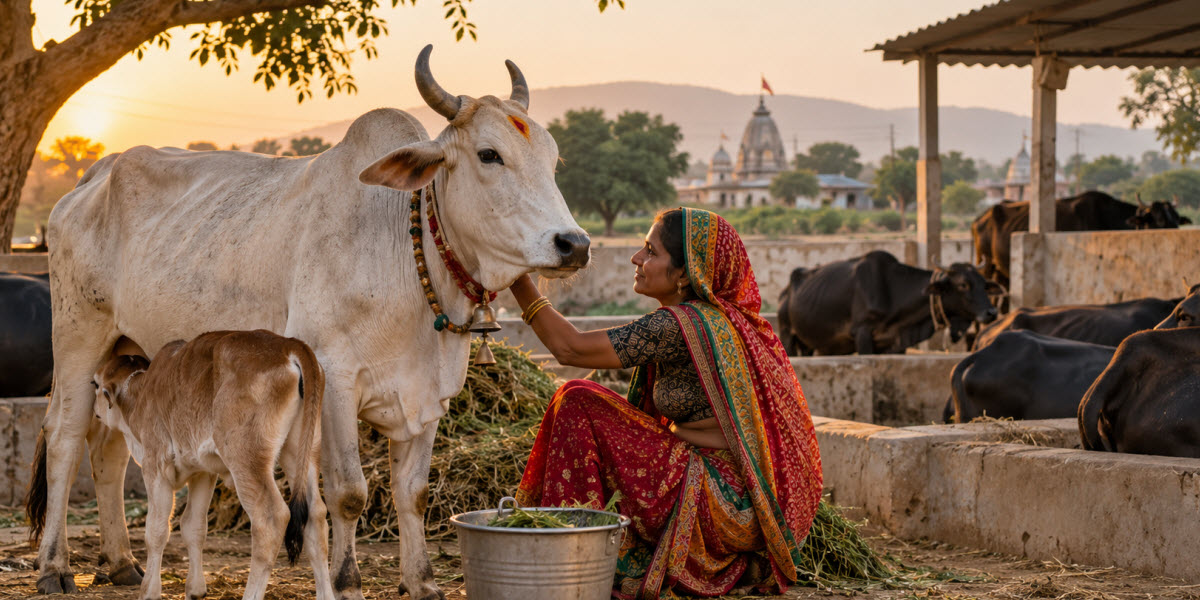
In India, particularly in the Hindu religion, the rights of animals to coexist with humans are recognized; therefore, people are taught to love, nurture, and worship them. The cow is the most sacred of all the animals of Hinduism. It is known as Kamadhenu, or the divine cow, and the giver of all desires. Likewise, the bull is depicted as a vehicle of Lord Shiva, symbolizing respect for male cattle. The cow was revered as a mother goddess in the Mediterranean civilizations. The cow became celebrated in India, first during the Vedic period (1500–900 BCE) as a symbol of wealth. The Rigved refers to the cow as devi or goddess.
Animal husbandry is the backbone of Indian agriculture and a source of employment in rural areas for centuries, around which the entire system of rural economy has revolved around it. In India, about 20.5 million people depend upon livestock for their livelihood. Livestock contributed 16 per cent to the income of small farm households, as against an average of 14 per cent for all rural households. Livestock provides livelihood to two-thirds of the rural community. It also employs about 8.8 per cent of the population in India.
Dairy is one of the biggest agri-businesses in India and a significant contributor to the Indian economy. It is the largest single agricultural commodity with a 5.5 per cent share of the economy. India is the largest producer of milk globally with 247.87 million tonnes of production in 2024-25 and a 25 per cent share in global production (OECD and FAO, 2025). According to the 20th livestock census of India, the total cattle and buffalo population in the country was 192.49 million and 109.85 million during 2019. Total cattle and buffalo are increased by 0.8 per cent and 1.1 per cent over the previous Livestock census, 2012(Anonymous, 2021).
Commercial dairy farming with intensive management and confined conditions aims at high input-high output, use of high-producing breeds of cows and buffaloes, and use of modern production technology. However, high-producing animals in intensive systems are put under stress and suffer from health and welfare problems such as impaired reproduction, diseases such as mastitis, lameness, calf morbidity and mortality, and abnormal behavior (Kamboj and Kumar, 2014).
Among these, the Farm Animal Welfare Council (FAWC) designed guidelines known as “The Five Freedoms” to protect farm animals from unnecessary suffering and to promote good animal welfare and address both physical and mental suffering. These Five Freedoms define welfare as the freedom:
(1) from hunger and thirst
(2) from discomfort
(3) from pain, injury, or disease
(4) from fear and distress and
(5) to express normal behavior (FAWC, 2009).
The Government of India has constituted the “Rashtriya Kamdhenu Aayog (RKA)” in 2019 to organize animal husbandry on modern and scientific lines. The RKA will function as an integral part of ‘Rashtriya Gokul Mission’. The objective of RKA is conservation, protection, and development of cows and their progeny; for proper implementation of laws with respect to the prohibition of slaughter and/or cruelty to cows, and for giving direction to the cattle development program (Sasidhar, 2021).
The work on animal welfare has been started by a few devoted organizations such as People for Animals (PFA), Blue Cross, Compassion Unlimited Plus Action (CUPA), InterNICHE, KARUNA, Animal Birth Control (ABC), People for the Ethical Treatment of Animals (PETA), and various SPCA in the country, to name a few. The largest animal protection organization in India, with the aid of the activist and the state animal husbandry department, is People for Animals (PFA).
Animal welfare groups that, facing tremendous odds, such as budget constraints and federal department ignorance, do an exceptional job in improving the working conditions of animals in distress. Various agencies work on various facets of the welfare of animals. Some of them profess vegetarianism and make people know that they are kind to animals. Some others are active in building foster homes, animal shelters, sanctuaries, pinjrapoles, and gaushalas, where protection exists for animals and birds in distress. Several groups run animal and bird clinics and health care centers, operate mobile dispensaries, and maintain ambulance vehicles for transporting sick and wounded animals.
The National Institute of Animal Welfare (NIAW) is established as a subordinate office of the Government of India under the Ministry of Environment and Forests at Ballabgarh, Haryana, with the mandate of promoting animal welfare in the country. The veterinary profession is devoted to promoting animal welfare through the art and science of keeping animals healthy through consideration of good husbandry, hygiene, preventive medicine, and prompt treatment of injury and disease, but it lacks attention to the study of how the animal feels. The veterinary graduates need more education on animal welfare as defined by the physical and emotional state of the animal.
Religious beliefs in many parts of India have exerted a special influence on the human-animal bond and, hence, the welfare of animals. Much of the Indian population follows Hinduism, a religion that holds cattle sacred; consequently, most states do not permit the slaughter of dairy cattle for meat, and non-productive animals may be housed in shelters known as gaushalas until they die of natural causes (Sharma et al., 2019).
Dogs have been associated with humans for many thousands of years. They continue to fulfill many roles in different societies, but the majority are now classified as companion animals and share a unique relationship with people living in their homes. The camel is considered a favorite in the popular folk tradition and literature. There are several goddesses depicted as riding on a camel. The Raikas are the largest pastoralist caste of western Rajasthan, and take pride in the fact that for them, camel breeding is not just a business but their heritage.
Raika believes that God Shiva created their caste to take care of dromedary camels. In the Mewar region of Rajasthan, Chetak Smarak is a memorial to Maharana Pratap’s famed steed Chetak, which died of battle wounds after helping the Rana from the battle of Haldighati.
Author
Karishma Choudhary and Vinod Kumar Palsaniya
Ph.D. Scholar (LPM), CVAS, Navania, Udaipur (RAJUVAS)
