
22 Oct Profitable Agriculture Business Ideas in India: Investment, Benefits and How to Start
Agriculture is not limited to growing crops and selling them in the market. There are many business opportunities in farming, food processing, agricultural services, livestock, and the supply of farming products. With the right planning, farmers and entrepreneurs can build a business that serves local farmers, wholesalers, retailers, restaurants, and consumers.
If you are looking for profitable agriculture business ideas in India, you do not always need to purchase a large farm or invest a huge amount of money. Some businesses can be started on a small scale, while others require land, machinery, technical knowledge, or working capital.
The most suitable business depends on your location, available resources, local demand, and ability to manage costs. In this guide, we will explore agriculture business opportunities in India, estimated investment requirements, possible income sources, and practical steps to get started.
Best Agriculture Business Ideas in India
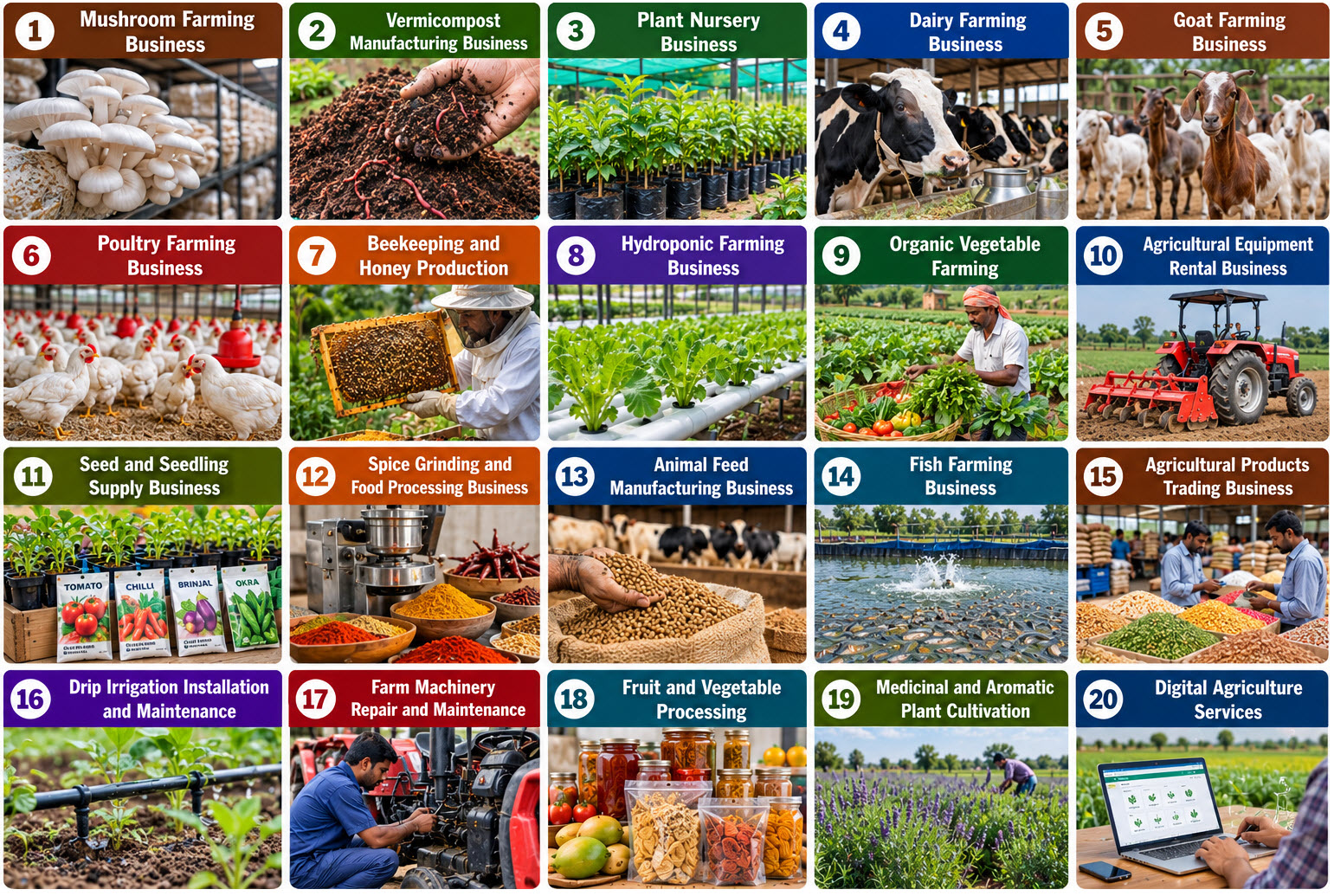
Here are some agriculture-related businesses worth considering:
- Mushroom farming
- Vermicompost and organic manure production
- Plant nursery business
- Dairy farming
- Goat farming
- Poultry farming
- Beekeeping and honey production
- Hydroponic farming
- Organic vegetable farming
- Agricultural equipment rental
- Seed and seedling supply
- Spice grinding and food processing
- Animal feed manufacturing
- Fish farming
- Agricultural products trading
- Drip irrigation installation and maintenance
- Farm machinery repair services
- Fruit and vegetable processing
- Medicinal and aromatic plant cultivation
- Digital agriculture services
Not every business is suitable for every region. Before investing, study local demand, production costs, selling prices, competition, and the availability of reliable buyers.
1. Mushroom Farming Business
Mushroom cultivation is an option for people who want to start an agricultural business without owning a large area of farmland. Depending on the mushroom variety, it may be possible to use a clean room, shed, or other suitable growing space.
Oyster mushrooms are often considered by beginners because their cultivation methods can be relatively simple to learn. Button mushrooms and other varieties may require different temperature and environmental conditions.
Investment required
A small trial unit may require approximately ₹10,000 to ₹50,000. A larger commercial setup can cost considerably more, depending on the growing room, racks, humidity control, raw materials, and production capacity.
How to earn money
- Sell fresh mushrooms to vegetable retailers.
- Supply restaurants, hotels, and caterers.
- Sell directly to households.
- Explore dried mushroom products after checking demand and food-processing requirements.
How to start
First, learn the cultivation process from a credible agricultural training centre or Krishi Vigyan Kendra. Start with a small batch, maintain hygiene, and identify buyers before increasing production.
Fresh mushrooms are perishable, so transport and timely sales are important. Contamination, temperature fluctuations, and poor-quality spawn can also affect production.
2. Vermicompost Manufacturing Business
Vermicompost is organic manure produced with the help of earthworms. It can be made using suitable organic waste, crop residues, and animal manure under properly managed conditions.
This business may be suitable for farmers, nurseries, gardening suppliers, and entrepreneurs who can access organic raw materials at a reasonable cost.
Investment required
A small unit may start with around ₹15,000 to ₹75,000, depending on the number of beds, shed arrangements, raw materials, labour, and packaging.
Potential customers
- Farmers
- Plant nurseries
- Gardening shops
- Landscaping companies
- Housing societies
- Home gardeners
- Organic farming suppliers
How to start
Arrange suitable raw materials, learn the correct composting process, and prepare a shaded production area with appropriate moisture management. Test the finished product and use clear packaging that explains the contents and quantity.
You can initially sell loose compost to nearby farmers. Later, you may introduce packaged products if there is sufficient demand.
The main business challenge is not simply producing compost. It is finding repeat buyers and controlling transportation and packaging costs.
3. Plant Nursery Business
A plant nursery involves growing and selling seedlings, saplings, ornamental plants, fruit plants, and other planting materials.
This business can work well near farming areas, towns, residential developments, and locations where landscaping and gardening services are in demand.
Investment required
A small nursery may require approximately ₹25,000 to ₹1.5 lakh. A commercial nursery with shade-net structures, irrigation systems, specialised plants, and larger inventory may require a substantially higher investment.
Products you can sell
- Vegetable seedlings
- Fruit tree saplings
- Flowering plants
- Ornamental plants
- Medicinal plants
- Grafted plants
- Seeds and potting mixtures
- Garden pots and accessories
How to start
Identify which plants are popular in your area. For example, a nursery serving vegetable growers may focus on vegetable seedlings, while one near urban housing societies may sell ornamental plants and gardening supplies.
Maintain healthy planting material, label plant varieties correctly, and provide basic growing instructions to customers.
You can also develop relationships with farmers, landscaping contractors, garden designers, and agricultural input retailers.
4. Dairy Farming Business
Dairy farming involves producing milk and selling it to dairy cooperatives, milk collection centres, processors, retailers, or consumers.
It can provide recurring sales when milk production and collection are consistent. However, dairy farming also requires daily care, suitable housing, clean water, quality feed, veterinary support, and reliable milk buyers.
Investment required
A small dairy operation may require approximately ₹1 lakh to ₹5 lakh or more, depending on the number and breed of animals, shed construction, equipment, feed arrangements, and local prices.
Purchasing animals is only one part of the total investment.
Revenue opportunities
- Fresh milk sales
- Curd and paneer production
- Ghee and other dairy products
- Sale of manure
- Breeding-related services, where appropriate
Processing milk into other products may require additional equipment, hygiene controls, food safety compliance, packaging, and a suitable sales network.
How to start
Before purchasing animals, calculate the daily feed cost, expected milk yield, veterinary expenses, labour, transport, and selling price. Speak with local dairy cooperatives and experienced dairy farmers.
Do not calculate profit using milk sales alone. Feed and animal health expenses can significantly affect the final return.
5. Goat Farming Business
Goat farming can be an option for entrepreneurs in areas with suitable fodder, housing, veterinary support, and access to buyers.
Income may come from selling animals for meat, breeding stock, or other locally relevant products. The business model should be selected according to regional demand and animal management requirements.
Investment required
A small starter unit may require around ₹50,000 to ₹2 lakh or more. Costs depend on animal prices, housing, herd size, feed, vaccination, and veterinary care.
Important factors
- Choose breeds suited to local climate and production goals.
- Provide clean drinking water and balanced nutrition.
- Follow vaccination and parasite-control advice.
- Maintain appropriate housing and biosecurity.
- Identify buyers before expanding the herd.
Goat farming should not be treated as a guaranteed quick-profit business. Disease, mortality, feed shortages, and changes in animal prices can affect returns.
6. Poultry Farming Business
Poultry farming provides opportunities in broiler production, layer farming, chick rearing, and the supply of poultry-related products.
Broilers are generally raised for meat, while layer birds are managed for egg production. Each model has different infrastructure, feed, disease-control, and marketing requirements.
Investment required
A small poultry setup may cost approximately ₹50,000 to ₹3 lakh or more, depending on the scale, housing, equipment, and whether the business is independently operated or linked to a contract farming arrangement.
How to earn
- Sell broiler birds.
- Supply eggs to shops and households.
- Sell manure where suitable buyers are available.
- Explore chick rearing or other poultry services after gaining experience.
Before starting, understand feed prices, mortality risks, vaccination requirements, ventilation, electricity needs, and local market rates.
Contract farming arrangements should be reviewed carefully so that the payment terms, responsibilities, input costs, and quality requirements are clear.
7. Beekeeping and Honey Production
Beekeeping can provide an additional income source for suitable agricultural areas. Bees produce honey and can also support pollination in certain crops.
The success of the business depends on the availability of suitable flowering plants, climate, colony health, seasonal conditions, and access to buyers.
Investment required
A small trial operation may cost approximately ₹25,000 to ₹1 lakh, depending on the number of colonies, boxes, protective equipment, extraction equipment, training, and transport.
Ways to earn
- Sell honey directly to consumers.
- Supply honey to retailers.
- Develop a packaged honey brand.
- Supply beeswax or other suitable hive products.
- Provide pollination services where demand exists.
How to start
Attend practical beekeeping training before purchasing colonies. Learn how to manage pests, protect colonies, harvest honey hygienically, and maintain product quality.
If you sell packaged honey, check the applicable food safety, labelling, testing, and licensing requirements.
8. Hydroponic Farming Business
Hydroponics is a method of growing plants without conventional soil, using a managed nutrient solution or another suitable growing medium.
It can be useful where land is limited and there is access to water, reliable electricity, suitable growing conditions, and a market for premium-quality produce.
Investment required
A small demonstration system may cost approximately ₹50,000 to ₹2 lakh. A commercial greenhouse or controlled-environment farm can cost several lakhs or more.
Suitable crops
- Lettuce
- Basil
- Other leafy greens
- Selected herbs
- Certain varieties of tomato and cucumber
Crop suitability depends on the system, climate, and production experience.
How to start
Research the local demand for hydroponic produce before purchasing equipment. Speak with restaurants, speciality grocery stores, and other potential buyers.
Calculate the costs of nutrients, electricity, water management, labour, packaging, cooling, and delivery.
Hydroponics is not automatically more profitable than conventional farming. A well-designed system can still lose money if selling prices are too low or customers are difficult to find.
9. Organic Vegetable Farming
Organic vegetable farming focuses on approved organic production methods and appropriate soil and pest management practices.
Potential customers include local households, speciality retailers, restaurants, and businesses that want traceable produce.
Investment required
A small trial plot may require around ₹20,000 to ₹1 lakh, excluding land purchase and depending on irrigation, seeds, compost, tools, labour, and crop selection.
How to earn
- Sell vegetables directly to households.
- Supply local retailers.
- Offer weekly vegetable baskets.
- Sell through farmers’ markets where available.
- Build relationships with restaurants and local food businesses.
How to start
Choose crops based on local demand, growing season, water availability, and expected selling prices. Plan succession planting so that several crops do not mature at the same time.
If you want to market produce as certified organic, understand the applicable certification and labelling rules. Avoid making organic certification claims without meeting the relevant requirements.
10. Agricultural Equipment Rental Business
Many small farmers need access to farm machinery but may not be able to justify purchasing every machine they use.
An agricultural equipment rental business provides machinery and related services to farmers on an hourly, daily, or task-based basis.
Equipment options
- Power tillers
- Power weeders
- Sprayers
- Seed drills
- Rotavators
- Chaff cutters
- Harvesting equipment
- Other locally demanded implements
Investment required
A small service using one or two suitable machines may require approximately ₹50,000 to ₹3 lakh or more. Tractors and larger machinery can increase the investment substantially.
How to start
Survey nearby villages and find out which machines farmers need most often. Estimate the number of paid operating hours per season, fuel costs, operator wages, maintenance, transport, insurance, and financing expenses.
You can begin with a single high-demand machine rather than purchasing a full range of equipment.
A booking register, WhatsApp contact number, clear rental rates, and reliable service can help build repeat business.
11. Seed and Seedling Supply Business
Farmers need quality seeds and healthy seedlings for every growing season. A seed supply business can serve vegetable growers, field-crop farmers, kitchen gardeners, and nurseries.
Investment required
A small trading operation may require approximately ₹50,000 to ₹2 lakh or more, depending on the product range, storage, premises, inventory, and working capital.
Products to consider
- Vegetable seeds
- Field-crop seeds
- Flower seeds
- Seedling trays
- Nursery supplies
- Growing media
- Selected planting materials
How to start
Study the crops commonly grown in your area and identify the sowing calendar. Work with reputable suppliers, maintain correct storage conditions, and keep proper records of stock and expiry dates.
Check applicable seed licensing and quality requirements before selling regulated products. Do not sell unverified seeds or make unsupported claims about germination and yield.
12. Spice Grinding and Food Processing Business
Processing agricultural products can create value beyond selling raw produce. For example, farmers or entrepreneurs may process chillies, turmeric, coriander, cumin, or other locally available crops into marketable products.
Investment required
A small grinding and packing operation may require approximately ₹1 lakh to ₹5 lakh or more, depending on machinery, premises, electrical requirements, packaging, and working capital.
Business opportunities
- Turmeric powder
- Chilli powder
- Coriander powder
- Mixed spice blends
- Millet flour
- Grain cleaning and milling
- Locally popular processed food products
How to start
Select products with dependable demand and a reliable supply of raw materials. Compare the cost of buying raw produce, processing losses, grinding, packaging, transport, and retailer margins.
Start with a limited product range and test sales with local shops and direct customers.
Packaged food businesses must check applicable FSSAI registration or licensing requirements, food safety standards, and labelling rules.
13. Animal Feed Manufacturing Business
Dairy farmers, poultry farmers, goat rearers, and other livestock owners need suitable feed throughout the year.
An animal feed business can involve manufacturing, mixing, distributing, or retailing feed products, depending on available capital and technical expertise.
Investment required
A small distribution business may require approximately ₹50,000 to ₹2 lakh or more. Manufacturing can require a higher investment in machinery, storage, raw materials, quality control, and working capital.
How to start
Identify the livestock and poultry farms in your target area. Find out which feed products they buy, how frequently they purchase them, and what problems they face with existing suppliers.
For manufacturing, obtain proper technical guidance on nutrition, ingredient quality, formulation, storage, and applicable regulations. Incorrect feed formulations can harm animals and damage your business reputation.
14. Fish Farming Business
Fish farming involves raising fish in suitable ponds or other managed systems for sale to consumers, retailers, restaurants, or wholesalers.
It is most suitable where water availability, site conditions, fish seed supply, technical knowledge, and market access are favourable.
Investment required
A small fish farming project may require approximately ₹1 lakh to ₹5 lakh or more, excluding major land costs and depending on pond construction, water management, fish seed, feed, equipment, and operating expenses.
How to start
Consult the local fisheries department before choosing a fish species or investing in pond development. Understand stocking density, water quality, feeding, disease prevention, harvesting, and local permissions.
Estimate the time required before fish can be sold. Feed costs, water quality problems, and market price fluctuations can affect profitability.
15. Agricultural Products Trading Business
Agricultural trading connects farmers with buyers who need grains, pulses, oilseeds, fruits, vegetables, spices, or other agricultural commodities.
You may work as a commission agent where legally permitted, a trader, a bulk supplier, or a distributor. The appropriate business structure depends on local regulations and the market in which you operate.
Investment required
A small trading operation may require approximately ₹1 lakh to ₹5 lakh or more in working capital. The actual requirement depends on commodity prices, order size, transport, storage, and payment cycles.
How to start
- Identify one or two commodities with regular local demand.
- Build relationships with farmers and buyers.
- Understand grading and quality requirements.
- Calculate transport, loading, market fees, wastage, and storage costs.
- Check payment terms before supplying large orders.
- Verify applicable mandi, trader, and food business requirements.
Trading can generate turnover quickly, but high turnover does not necessarily mean high profit. Credit defaults, spoilage, price movements, and unsold stock can create substantial losses.
16. Drip Irrigation Installation and Maintenance
Drip irrigation services help farmers install, repair, and maintain systems that deliver water near plant roots.
This business may suit people with technical skills who can work with irrigation suppliers and farmers growing vegetables, fruit crops, flowers, and other suitable crops.
Investment required
A small service business may require approximately ₹50,000 to ₹2 lakh for tools, training, transport, demonstration equipment, and initial supplies. A business that also stocks irrigation products may need more capital.
Services to offer
- Drip system installation
- Filter cleaning and maintenance
- Pipe and emitter repairs
- Irrigation scheduling support
- System inspections
- Replacement parts and accessories
How to start
Learn the technical requirements of irrigation design and installation. Develop relationships with farmers, nurseries, and authorised equipment suppliers.
Where subsidy-supported installations are involved, follow the relevant state’s current approved procedures. Never promise a subsidy or guaranteed approval to a customer.
17. Farm Machinery Repair and Maintenance
Agricultural machinery needs regular servicing, especially during sowing and harvesting seasons.
A repair and maintenance service can support farmers who use power tillers, pumps, sprayers, tractors, and other agricultural equipment.
Investment required
A small repair workshop may require approximately ₹50,000 to ₹2 lakh or more, depending on tools, spare parts, premises, transport, and technical training.
How to start
Gain practical experience in machinery repair and focus on commonly used equipment in your area. Keep essential spare parts in stock and offer timely service during peak agricultural periods.
You can also provide scheduled maintenance to farmers and machinery rental businesses.
18. Fruit and Vegetable Processing
Fresh fruits and vegetables often have a limited selling period. Processing suitable produce into products with a longer shelf life can help businesses reach additional customers.
Product ideas
- Dried fruit
- Dehydrated vegetables
- Pickles
- Fruit pulp
- Jams
- Tomato-based products
- Dried onion and garlic
- Ready-to-cook vegetable ingredients
Investment required
A small processing unit may require approximately ₹1 lakh to ₹5 lakh or more. The actual cost depends on processing methods, drying equipment, storage, packaging, food safety requirements, and production capacity.
How to start
Choose a product that uses locally available raw materials and has identifiable buyers. Test the recipe, shelf life, packaging, and pricing before investing in larger machinery.
Check the applicable food safety, labelling, testing, and licensing requirements. Products must be processed and stored safely.
19. Medicinal and Aromatic Plant Cultivation
Certain medicinal and aromatic plants can offer business opportunities where the climate, soil, production practices, and market conditions are suitable.
Possible crops include lemongrass, selected aromatic grasses, and other regionally appropriate plants.
Investment required
The investment varies significantly with the crop, acreage, planting material, irrigation, harvesting, and processing requirements.
How to start
Do not select a crop only because someone claims it provides high returns. Contact potential buyers and obtain clear information about the variety, quality specifications, quantity required, purchase price, and delivery arrangements.
If the business requires distillation or extraction, calculate the cost of machinery, energy, transport, and processing capacity before investing.
20. Digital Agriculture Services
Agriculture also offers opportunities for people with computer, marketing, data management, or technology skills.
A digital agriculture business can provide useful information and services to farmers, agricultural suppliers, and rural businesses.
Business opportunities
- Agricultural websites and educational content
- Crop planning and farm record software
- Digital marketing for agricultural companies
- Online directories of agricultural suppliers
- Farm product lead generation
- Agricultural marketplace development
- Local-language educational videos
- Online booking for farm machinery services
Investment required
A basic service business can sometimes begin with ₹10,000 to ₹50,000, depending on equipment, software, marketing, and the services offered.
How to earn money
- Website advertising
- Sponsored educational content with clear disclosures
- Lead generation for relevant businesses
- Digital marketing services
- Subscription-based software
- Paid business listings
- Online sales of agricultural products
The best approach is to solve a specific problem for farmers or agricultural businesses. For example, a local-language website that provides useful crop information and connects farmers with verified suppliers may create value for both readers and businesses.
Avoid publishing unverified agricultural advice or mass-producing pages that provide little original value.
Agriculture Business Ideas Based on Investment
The following figures are broad planning estimates for small operations, not official cost benchmarks. Land purchase, major construction, and some large equipment expenses may be excluded.
| Business idea | Indicative starting investment | Main requirement |
|---|---|---|
| Digital agriculture services | ₹10,000–₹50,000 | Computer and practical skills |
| Mushroom farming | ₹10,000–₹50,000 | Suitable growing space |
| Vermicompost production | ₹15,000–₹75,000 | Organic raw materials |
| Small plant nursery | ₹25,000–₹1.5 lakh | Space and water |
| Beekeeping | ₹25,000–₹1 lakh | Training and suitable location |
| Seed supply | ₹50,000–₹2 lakh | Inventory and compliance |
| Farm machinery repair | ₹50,000–₹2 lakh | Technical skills |
| Goat farming | ₹50,000–₹2 lakh or more | Housing and animal care |
| Poultry farming | ₹50,000–₹3 lakh or more | Housing and management |
| Dairy farming | ₹1 lakh–₹5 lakh or more | Animals, feed and buyers |
| Fish farming | ₹1 lakh–₹5 lakh or more | Suitable water facilities |
| Food processing | ₹1 lakh–₹5 lakh or more | Equipment and food safety |
Your actual startup cost may be higher or lower. Obtain local quotations and prepare a detailed budget before committing money.
Which Agriculture Business Is Best for Beginners?
There is no single agriculture business that is best for everyone. A suitable choice depends on your experience, resources, and access to customers.
If you have a limited budget
Consider a small mushroom cultivation trial, vermicompost production, digital agriculture services, or a basic agricultural supply service. Start with a manageable workload and validate demand before expanding.
If you have agricultural land
You could explore a plant nursery, vegetable cultivation, compost production, or another crop suited to your soil, water availability, and market.
If you live near a town or city
A nursery, vegetable supply service, gardening products business, or digital service for agricultural companies may benefit from access to urban customers.
If you have technical skills
Agricultural equipment repair, irrigation installation, farm record software, and digital marketing for agricultural businesses are worth evaluating.
If you have experience with livestock
Dairy farming, goat farming, poultry, or animal feed distribution may be suitable, provided you can manage daily operations and have reliable buyers.
If you have access to agricultural produce
Spice processing, grain milling, fruit processing, or agricultural trading may offer opportunities to add value to locally available products.
How to Start an Agriculture Business in India
Starting with a practical plan can help reduce avoidable losses.
Step 1: Research local demand
Speak with farmers, retailers, wholesalers, restaurants, and agricultural suppliers. Ask what they buy regularly, what problems they face, and whether they would consider buying from a new supplier.
Step 2: Select one business model
Choose a business that matches your available capital, skills, and location. Avoid investing in several unrelated activities at the same time.
Step 3: Prepare a cost estimate
Include equipment, rent, raw materials, transport, electricity, labour, packaging, marketing, repairs, and working capital.
Keep a separate reserve for unexpected expenses.
Step 4: Identify buyers before production
Whenever possible, obtain buyer feedback, sample orders, or written expressions of interest before purchasing expensive equipment or producing large quantities.
Step 5: Start on a small scale
Run a pilot project to understand actual costs, product quality, customer response, and operating challenges.
Increase production only when you have evidence of repeat demand.
Step 6: Check registration and licences
Depending on the activity, you may need business registration, GST registration where applicable, FSSAI registration or licensing, seed or input licences, local permissions, or other approvals.
Confirm the requirements with the relevant government department or qualified professional.
Step 7: Explore suitable financial support
Depending on your business, location, eligibility, and project structure, you may be able to explore bank finance, agricultural infrastructure support, food-processing programmes, or entrepreneurship initiatives.
Check the latest scheme guidelines before making financial decisions.
Government Schemes for Agriculture Businesses in India
The Government of India and state governments operate programmes that support different parts of agriculture and rural entrepreneurship. The scheme that applies to you will depend on your business activity and eligibility.
1. Agriculture Infrastructure Fund
The Agriculture Infrastructure Fund has supported financing for eligible agricultural infrastructure projects. Entrepreneurs should check the current scheme provisions, eligible assets, lending conditions, and application process.
Official website: https://agriinfra.dac.gov.in/
2. Rashtriya Krishi Vikas Yojana – RAFTAAR
Agricultural entrepreneurs and startups can explore relevant innovation, incubation, and business-development opportunities under applicable RKVY-RAFTAAR programmes.
Official information: https://rkvy.da.gov.in/
3. AgriSURE
AgriSURE is an initiative focused on supporting eligible agriculture and rural enterprise startups through its designated funding framework. Check the current investment criteria and application information.
Official information: https://www.nabard.org/agrisure.aspx
4. Mission for Integrated Development of Horticulture
Entrepreneurs and growers involved in eligible horticultural activities can check the current MIDH guidelines and the relevant state horticulture department for available support.
5. PM Formalisation of Micro Food Processing Enterprises
Small food-processing businesses may investigate the PMFME programme and its current implementation status, eligible activities, and application conditions.
Official information: https://mofpi.gov.in/
6. Agriculture and allied-sector training
Krishi Vigyan Kendras, agricultural universities, state departments, and recognised training centres can provide practical guidance in cultivation, livestock management, processing, and other agricultural activities.
You can also consult the official agricultural research and extension resources available through the Indian Council of Agricultural Research.
Important: A scheme listing does not guarantee that applications are currently open or that your project qualifies. Verify the latest guidelines, subsidy availability, eligible costs, and application route before making an investment.
How to Calculate Profit in an Agriculture Business
Before starting, calculate expected revenue and expenses using realistic local figures.
Basic formula:
Net operating profit = Total sales revenue − Total operating expenses
For example, suppose a small agricultural products business has the following monthly figures:
- Total sales: ₹1,00,000
- Raw materials: ₹45,000
- Packaging and transport: ₹12,000
- Labour and utilities: ₹15,000
- Rent, maintenance, and other operating costs: ₹8,000
Total operating expenses would be ₹80,000, leaving an estimated operating profit of ₹20,000 before interest, tax, depreciation, and other excluded costs.
This is only an illustrative calculation, not a forecast for any particular agriculture business.
For farming, also account for seasonal expenses, crop losses, unsold produce, equipment depreciation, and the time between planting and receiving payment.
Common Mistakes to Avoid
Many agriculture businesses struggle because of poor planning rather than a lack of market opportunities.
Avoid these mistakes:
- Investing before checking local demand.
- Assuming advertised profit figures are guaranteed.
- Purchasing machinery that remains underused.
- Ignoring transport and storage expenses.
- Depending on a single buyer.
- Expanding before understanding production costs.
- Using poor-quality seeds, feed, or raw materials.
- Ignoring food safety and other legal requirements.
- Borrowing money without calculating repayment capacity.
- Assuming a government subsidy will automatically be approved.
Keep proper records of purchases, sales, stock, customer payments, and expenses from the beginning.
Frequently Asked Questions
Which agriculture business is best in India?
The right business depends on location, budget, skills, available land, and customer demand. Mushroom cultivation, plant nurseries, vermicompost, agricultural services, livestock, and food processing are among the options worth researching.
Which agriculture business can be started with ₹10,000?
A small trial of mushroom cultivation, a basic digital agriculture service, or another low-cost activity may be possible with ₹10,000. The feasibility depends on your existing equipment, available space, local costs, and access to customers.
Which agriculture business is suitable without farmland?
Digital agriculture services, agricultural product distribution, farm machinery repair, seed and gardening supply, and some small-scale processing or trading activities may be possible without owning farmland.
Is dairy farming profitable in India?
Dairy farming can be profitable when milk yield, feed costs, animal health, labour, and selling prices are managed well. It can also generate losses if operating costs are too high or milk production falls.
Can I start an agriculture business from home?
Some activities, such as digital agriculture services, certain nursery operations, and small-scale cultivation or product packaging where permitted, may be started from home. Check space, hygiene, zoning, licensing, and other applicable requirements.
Are government subsidies available for agriculture businesses?
Support may be available for eligible projects under selected central and state programmes. Eligibility, subsidy rates, application windows, and required documents vary. Confirm current details through official government sources.
How can I sell agricultural products directly to customers?
You can explore local retailers, farmers’ markets, WhatsApp business groups, online marketplaces, restaurants, and direct household deliveries. The appropriate method depends on product shelf life, delivery costs, and local regulations.
Final Thoughts
Profitable agriculture business ideas in India range from small-scale cultivation and agricultural services to livestock, food processing, and digital platforms. The best opportunity is not necessarily the one with the highest advertised profit. It is the one where you can meet a real customer need, control operating costs, maintain product quality, and build repeat sales.
Start by researching one business in your area. Speak to potential buyers, prepare a realistic budget, understand the relevant regulations, and test the idea on a manageable scale before expanding.
With careful planning and consistent execution, an agriculture-related business can become a practical source of income and employment.
Disclaimer: This article provides general educational information. Investment figures and business outcomes vary by location, scale, input prices, weather, market conditions, and management. Conduct local research and obtain professional advice where necessary before investing.
