
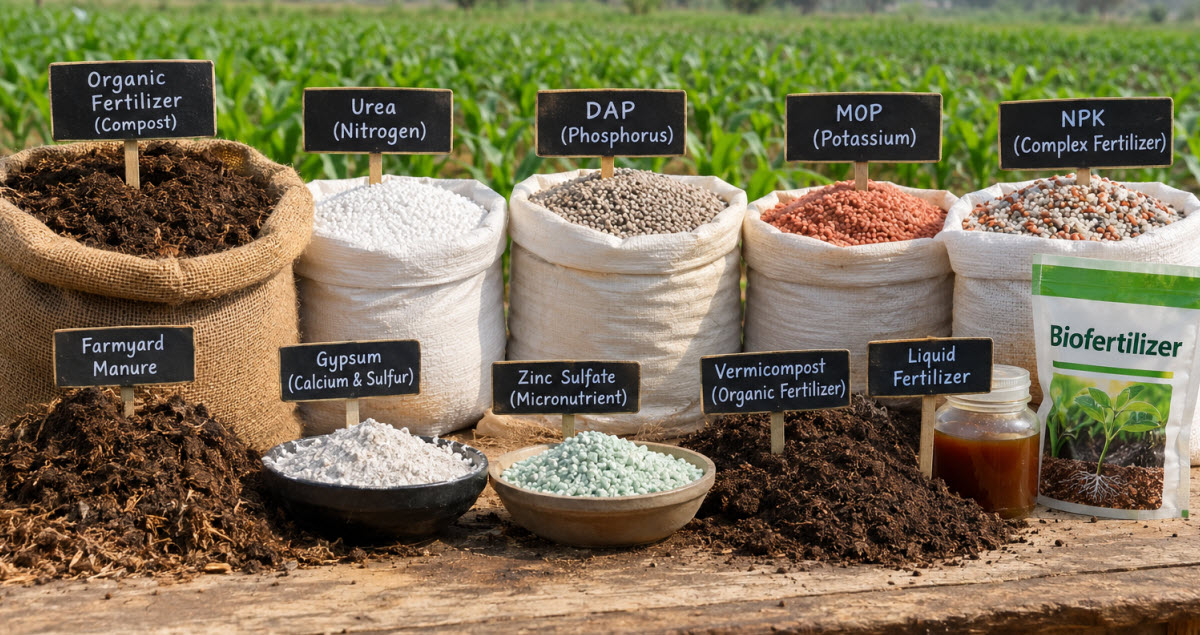
20 Oct Types of Fertilizers and Their Uses: A Complete Guide
Healthy crops need the right nutrients at the right time. When plants do not get enough nutrients from the soil, their growth may slow down, leaves may turn yellow, and crop production may decrease. Fertilizers help farmers supply these essential nutrients and maintain healthy crop growth.
Different fertilizers serve different purposes. Some help plants develop green leaves, while others support root growth, flowering, fruit development, and grain formation. Choosing the right fertilizer depends on the crop, soil condition, weather, and stage of plant growth.
In this article, we will explain the different types of fertilizers, their uses, common examples, and how farmers can choose the right fertilizer for their crops.
What Are Fertilizers?
Fertilizers are materials added to soil or plants to supply nutrients needed for healthy growth. These nutrients help plants produce leaves, develop roots, form flowers, and produce fruits or grains.
Plants need several nutrients throughout their growing period. The three main nutrients supplied through fertilizers are:
- Nitrogen (N): Helps plants develop green leaves and healthy vegetative growth.
- Phosphorus (P): Supports root development, early plant growth, and seed formation.
- Potassium (K): Helps regulate water movement, supports plant health, and contributes to crop quality.
Plants also need calcium, magnesium, sulfur, iron, zinc, boron, and other nutrients in different amounts. A shortage of any essential nutrient can affect crop growth and production.
Why Are Fertilizers Important in Agriculture?
Fertilizers are an important part of crop management because the nutrients available naturally in the soil may not always meet the needs of a growing crop. Harvesting also removes nutrients from agricultural fields.
Using the right fertilizer in the correct quantity can help farmers:
- Promote healthy leaf, stem, and root development.
- Improve crop growth when nutrient availability is limited.
- Support flowering, fruit development, and grain filling.
- Correct nutrient deficiencies in the soil.
- Maintain soil fertility by replacing nutrients removed during harvesting.
- Improve crop quality when nutrient deficiencies are affecting produce.
- Use fertilizer inputs more efficiently and avoid unnecessary expenses.
However, applying more fertilizer does not always result in a better harvest. Excessive application can damage crops, increase production costs, and contribute to water pollution. Farmers should choose fertilizers according to crop requirements and soil test results.
Types of Fertilizers and Their Uses
Fertilizers can be classified according to their source, nutrient content, and method of application. The following are the major types commonly used in agriculture.
1. Organic Fertilizers
Organic fertilizers are prepared from plant materials, animal waste, and other organic matter. They supply nutrients and help improve soil structure and biological activity.
Common examples include farmyard manure, compost, vermicompost, poultry manure, and oil cakes.
Main uses of organic fertilizers:
- Add organic matter to the soil.
- Improve soil structure and water-holding capacity.
- Support beneficial soil microorganisms.
- Supply nutrients as organic materials decompose.
- Help maintain soil productivity over time.
Common organic fertilizers include:
- Farmyard manure (FYM): Made from decomposed cattle dung and other farm materials. It supplies nutrients and adds organic matter to the soil.
- Compost: Prepared from decomposed leaves, crop residues, and suitable organic waste. It helps recycle farm waste and improve soil condition.
- Vermicompost: Produced with the help of earthworms. It is commonly used in vegetable cultivation, nurseries, and home gardens.
- Poultry manure: Contains nitrogen, phosphorus, and potassium. It should be properly treated and applied at a suitable rate.
- Neem cake: A by-product of neem oil extraction. It supplies nutrients and organic matter and can be included in certain integrated crop management practices.
Organic fertilizers are useful for many crops, but their nutrient content can vary. Well-decomposed materials should be preferred, and nutrient requirements should be considered before application.
2. Chemical or Mineral Fertilizers
Chemical fertilizers, also called mineral fertilizers, supply plant nutrients in concentrated forms. Their nutrient content is generally mentioned on the packaging, making it easier to calculate the required quantity.
Common examples include urea, diammonium phosphate (DAP), single superphosphate (SSP), muriate of potash (MOP), and NPK fertilizers.
Uses of mineral fertilizers:
- Supply specific nutrients to crops.
- Correct nutrient deficiencies.
- Support crop growth when soil nutrients are insufficient.
- Help farmers manage nutrient application according to crop requirements.
These fertilizers can be effective when used properly. Applying them without considering soil conditions, crop needs, or the recommended dose may waste money and harm the crop or environment.
3. Nitrogen Fertilizers
Nitrogen is essential for leaf development, chlorophyll production, and protein formation. Crops that do not receive enough nitrogen may show yellowing of older leaves and poor growth.
Nitrogen fertilizers are commonly used in cereals, vegetables, cotton, and many other crops.
| Fertilizer | Approximate nitrogen content | Main use |
|---|---|---|
| Urea | 46% | Promotes vegetative growth and supplies nitrogen. |
| Ammonium sulfate | 21% | Supplies nitrogen and sulfur. |
| Calcium ammonium nitrate (CAN) | Depends on grade, commonly around 25–26% | Supplies nitrogen and may provide calcium. |
| Ammonium chloride | Approximately 25–26% | Used in selected crops and suitable soil conditions. |
Uses of nitrogen fertilizers:
- Encourage green leaf growth.
- Support photosynthesis and protein formation.
- Promote tillering in crops such as wheat and rice.
- Support healthy vegetative growth in maize and vegetables.
Excess nitrogen can produce too much leafy growth, delay maturity, or increase lodging in some crops. Apply nitrogen at the recommended growth stages rather than using a larger dose than necessary.
4. Phosphorus Fertilizers
Phosphorus plays an important role in root development, energy transfer, early plant growth, and seed formation. It is especially important when crops are establishing their root systems.
Common phosphorus fertilizers include:
- Diammonium phosphate (DAP): Supplies nitrogen and phosphorus.
- Single superphosphate (SSP): Supplies phosphorus, calcium, and sulfur.
- Monoammonium phosphate (MAP): Supplies nitrogen and phosphorus.
- Triple superphosphate (TSP): Supplies concentrated phosphorus.
Uses of phosphorus fertilizers:
- Support early root development.
- Help young plants establish successfully.
- Contribute to flowering and seed development.
- Support energy transfer and normal plant growth.
Phosphorus is often applied near the root zone during planting because it moves relatively slowly through many soils. Avoid placing concentrated fertilizer directly against seeds or young roots.
5. Potassium Fertilizers
Potassium helps plants regulate water movement, activate enzymes, and maintain normal growth. It also contributes to crop quality and helps plants respond to certain environmental stresses.
The two common potassium fertilizers are:
- Muriate of potash (MOP): Potassium chloride, widely used in agriculture.
- Sulfate of potash (SOP): Potassium sulfate, which supplies potassium and sulfur.
Uses of potassium fertilizers:
- Support water regulation in plants.
- Contribute to healthy stems and plant development.
- Support grain filling and fruit development.
- Help maintain crop quality when potassium is insufficient.
MOP is suitable for many field crops, while SOP may be preferred for chloride-sensitive crops or where sulfur is also required. The correct choice depends on the crop, soil, and irrigation conditions.
6. NPK and Complex Fertilizers
NPK fertilizers supply nitrogen, phosphorus, and potassium in a single product. They are commonly used when crops need more than one primary nutrient.
Common NPK grades include 10:26:26, 12:32:16, 15:15:15, and 19:19:19.
For example, NPK 10:26:26 contains:
- 10% nitrogen (N).
- 26% phosphate expressed as P₂O₅.
- 26% potash expressed as K₂O.
The phosphorus and potassium figures are expressed as P₂O₅ and K₂O, not as elemental phosphorus and potassium.
Uses of NPK fertilizers:
- Supply multiple nutrients in one application.
- Support balanced crop nutrition when the grade is suitable.
- Simplify fertilizer planning.
- Help meet crop nutrient requirements during different growth stages.
Not every crop needs the same NPK ratio. Choose a fertilizer grade based on soil testing, crop recommendations, and the nutrients already supplied by manure or other fertilizers.
7. Secondary Nutrient Fertilizers
Plants require calcium, magnesium, and sulfur in relatively large amounts compared with micronutrients. These are known as secondary nutrients.
- Calcium: Supports cell wall development and healthy growing tissues.
- Magnesium: Forms part of chlorophyll and supports photosynthesis.
- Sulfur: Helps plants form certain amino acids and proteins.
Examples of fertilizers supplying these nutrients include gypsum, magnesium sulfate, and ammonium sulfate.
Uses of secondary nutrient fertilizers:
- Correct calcium, magnesium, or sulfur deficiencies.
- Support normal plant development.
- Maintain nutrient balance in the soil.
- Improve crop growth when a secondary nutrient is limiting production.
The fertilizer should match the actual nutrient requirement. For example, gypsum supplies calcium and sulfur, but it does not replace agricultural lime when the main purpose is to raise soil pH.
8. Micronutrient Fertilizers
Micronutrients are required in small quantities, but they are essential for normal plant growth. A deficiency can affect leaf colour, flowering, fruit development, and crop yield.
Important micronutrients include zinc, iron, boron, manganese, copper, molybdenum, chlorine, and nickel.
Common examples include:
- Zinc sulfate: Used to correct zinc deficiency in crops such as rice, wheat, and maize.
- Ferrous sulfate: Supplies iron, which supports chlorophyll formation.
- Borax: Supplies boron, which is important for growing tissues and reproductive development.
- Manganese sulfate: Supplies manganese for essential plant processes.
Uses of micronutrient fertilizers:
- Correct specific nutrient deficiencies.
- Support enzyme activity and photosynthesis.
- Help maintain healthy leaves and growing tissues.
- Support flowering, fruiting, and seed development when the relevant nutrient is needed.
Micronutrients should not be applied in excess. Some, particularly boron, can become toxic if the dose is too high. Soil testing and crop-specific advice help farmers select the right product and application rate.
9. Biofertilizers
Biofertilizers contain beneficial living microorganisms that support nutrient availability or help plants obtain nutrients. They are used as part of an integrated nutrient management programme.
Common examples include Rhizobium, Azotobacter, Azospirillum, and phosphate-solubilizing microorganisms.
- Rhizobium: Forms root nodules with suitable legume crops such as chickpea, soybean, and pigeon pea. These bacteria help fix atmospheric nitrogen.
- Azotobacter: A free-living microorganism used in certain crop systems to support biological nitrogen inputs.
- Azospirillum: Associates with plant roots and is used in some cereal and grass-based cropping systems.
- Phosphate-solubilizing microorganisms: Help make certain forms of soil phosphorus more available to plants.
- Blue-green algae: Certain cyanobacteria are used in suitable rice cultivation systems to contribute biological nitrogen.
Biofertilizers can help improve nutrient management, but their performance depends on product quality, crop compatibility, soil conditions, and correct application. They should not be assumed to replace all mineral fertilizer requirements.
10. Slow-Release and Controlled-Release Fertilizers
Slow-release and controlled-release fertilizers are designed to supply nutrients over a longer period than many conventional fertilizers.
Some products release nutrients gradually through decomposition, while coated fertilizers regulate the release of nutrients through a protective coating.
Uses of slow-release fertilizers:
- Supply nutrients over an extended period.
- Reduce the need for frequent applications in suitable systems.
- Help match nutrient availability with plant demand.
- Potentially reduce nutrient losses when properly selected and managed.
These fertilizers are used in selected agricultural crops, nurseries, container plants, and landscaping. Their cost and nutrient release characteristics should be considered before use.
11. Liquid Fertilizers
Liquid fertilizers contain one or more plant nutrients in a solution or suspension. They are useful in farming systems where nutrients need to be supplied through irrigation or by a suitable foliar spray.
Examples include liquid NPK fertilizers, water-soluble fertilizers, and liquid micronutrient formulations.
Uses of liquid fertilizers:
- Supply nutrients through drip irrigation systems.
- Support nutrient management in vegetables and fruit crops.
- Help correct certain nutrient deficiencies through foliar application.
- Allow nutrient application at selected crop growth stages.
Use only products suitable for the intended application method. Incorrect foliar concentrations can burn leaves, while unsuitable fertilizer mixtures can cause deposits or clog irrigation equipment.
Fertilizer Types and Their Uses at a Glance
| Fertilizer type | Examples | Main use |
|---|---|---|
| Organic fertilizers | FYM, compost, vermicompost | Add organic matter and supply nutrients. |
| Nitrogen fertilizers | Urea, ammonium sulfate | Support leaf and vegetative growth. |
| Phosphorus fertilizers | DAP, SSP, MAP | Support root growth and seed development. |
| Potassium fertilizers | MOP, SOP | Support water regulation and crop quality. |
| NPK fertilizers | 10:26:26, 12:32:16 | Supply multiple primary nutrients. |
| Secondary nutrient fertilizers | Gypsum, magnesium sulfate | Supply calcium, magnesium, or sulfur. |
| Micronutrient fertilizers | Zinc sulfate, borax | Correct specific micronutrient deficiencies. |
| Biofertilizers | Rhizobium, Azospirillum | Support biological nutrient processes. |
| Slow-release fertilizers | Coated fertilizer products | Release nutrients over an extended period. |
| Liquid fertilizers | Liquid NPK, soluble micronutrients | Supply nutrients through suitable liquid application methods. |
Which Fertilizer Is Best for Different Crops?
The best fertilizer depends on the crop, soil fertility, variety, growing season, irrigation method, and expected yield. The following examples explain the general nutrient needs of some common crops.
Fertilizers for Rice
Rice needs balanced nutrition throughout its growing period. Nitrogen supports leaf growth and tillering, phosphorus supports early root development, and potassium contributes to plant health.
Nitrogen is commonly applied in split doses according to local recommendations and crop growth stage. Soil testing can also help identify the need for sulfur, zinc, or other nutrients.
Fertilizers for Wheat
Wheat requires nitrogen for vegetative growth and grain formation. Phosphorus supports early root development, while potassium is important where the soil cannot supply enough of it.
The fertilizer schedule should consider soil-test results, the previous crop, irrigation availability, and the recommended nitrogen application stages.
Fertilizers for Cotton
Cotton requires balanced nutrition for vegetative growth, flowering, boll development, and fibre production. Nitrogen and potassium are important, but their requirements depend on the soil and crop condition.
Excess nitrogen may encourage too much vegetative growth and interfere with normal boll development. Farmers should follow locally recommended fertilizer rates and check for micronutrient deficiencies when necessary.
Fertilizers for Vegetables
Vegetable crops may require careful nutrient management because their growing seasons can be short and their nutrient needs can change quickly.
Suitable NPK fertilizers, compost, and specific micronutrients may be used according to the crop and soil condition. Drip irrigation with fertigation can be useful in suitable production systems.
Fresh manure should not be applied directly to edible plant parts. Properly treated manure and recommended waiting periods help reduce food safety risks.
Fertilizers for Fruit Crops
Fruit crops such as mango, banana, citrus, and grapes have different nutrient requirements. Their needs depend on plant age, soil condition, crop load, and growing environment.
Organic matter, nitrogen, phosphorus, potassium, and selected micronutrients may be included in a crop nutrition programme. Soil testing and, where appropriate, leaf analysis can help guide fertilizer decisions.
How to Choose the Right Fertilizer
Selecting the right fertilizer helps farmers meet crop nutrient requirements without spending money on unnecessary inputs.
- Test the soil: A soil test helps identify nutrient availability and soil pH.
- Understand the crop: Check the nutrient requirements of the crop being cultivated.
- Consider the growth stage: Young plants, flowering crops, and fruiting crops may need different nutrient management.
- Check the fertilizer grade: Read the nutrient percentages on the package before selecting a product.
- Calculate the quantity: Follow the recommended nutrient dose and account for the nutrient content of the fertilizer.
- Consider organic inputs: Include the nutrients supplied by manure, compost, and other soil amendments where appropriate.
- Choose the right application method: Broadcasting, placement, top dressing, fertigation, and foliar spraying suit different products and situations.
- Observe crop growth: Investigate possible nutrient deficiencies before adding more fertilizer.
Common Methods of Fertilizer Application
1. Broadcasting
Broadcasting means spreading fertilizer over the soil surface. It may be carried out before planting or during crop growth when the product and crop management system are suitable.
2. Fertilizer Placement
Placement involves putting fertilizer in a band or near the root zone. It can improve nutrient access, but concentrated fertilizer should not come into direct contact with seeds or young roots.
3. Top Dressing
Top dressing involves applying fertilizer to an established crop, often to supply nitrogen during active growth. The timing depends on crop requirements, weather, and irrigation conditions.
4. Fertigation
Fertigation is the application of suitable water-soluble fertilizers through an irrigation system. It is commonly used in drip-irrigated vegetables, fruit crops, and protected cultivation.
5. Foliar Application
Foliar application involves spraying a suitable fertilizer solution onto plant leaves. It can help correct certain nutrient deficiencies, but it generally cannot replace the full nutrient requirements of a crop.
Always follow the fertilizer label and local agricultural recommendations when selecting an application method.
Common Fertilizer Application Mistakes to Avoid
Incorrect fertilizer use can increase cultivation costs and affect crop growth. Farmers should avoid the following mistakes:
- Applying fertilizer without considering soil nutrient status.
- Using more nitrogen than the crop needs.
- Placing concentrated fertilizer too close to seeds or roots.
- Applying fertilizer immediately before heavy rainfall.
- Using micronutrients without confirming the need.
- Ignoring nutrients already supplied by manure or other fertilizers.
- Using unsuitable fertilizer mixtures in drip irrigation systems.
- Failing to calibrate fertilizer application equipment.
- Storing fertilizers in damp conditions or near children and animals.
Store fertilizers according to the manufacturer’s instructions. Avoid spills and prevent fertilizer from entering wells, ponds, streams, and other water sources.
Organic Fertilizers vs Chemical Fertilizers
Organic and mineral fertilizers work in different ways. Both can be useful when selected according to soil conditions and crop requirements.
| Feature | Organic fertilizers | Mineral fertilizers |
|---|---|---|
| Source | Plant and animal materials | Mined or manufactured nutrient materials |
| Nutrient content | Usually variable | Generally specified on the label |
| Nutrient availability | Often depends on decomposition | Depends on the fertilizer formulation |
| Organic matter | Adds organic matter | Generally does not add organic matter |
| Nutrient planning | Requires estimating available nutrients | Often allows more precise nutrient calculations |
| Main role | Soil improvement and nutrient recycling | Supplying nutrients according to crop needs |
Neither type is automatically best for every situation. Many farmers benefit from combining suitable organic materials with mineral fertilizers as part of an integrated nutrient management programme.
What Is Integrated Nutrient Management?
Integrated Nutrient Management (INM) combines mineral fertilizers, organic materials, biological inputs, and good soil management practices to meet crop nutrient requirements.
An integrated nutrient management programme may include:
- Applying fertilizers according to soil-test recommendations.
- Using properly decomposed farmyard manure or compost.
- Returning suitable crop residues to the soil.
- Using crop-specific biofertilizers where appropriate.
- Including legumes in crop rotations where suitable.
- Applying nutrients at the correct rate, time, and place.
- Managing irrigation to reduce nutrient losses.
The aim is to maintain crop productivity, use nutrients efficiently, manage cultivation costs, and protect soil and water resources.
Frequently Asked Questions About Fertilizers
1. What are the main types of fertilizers?
The main types include organic fertilizers, nitrogen fertilizers, phosphorus fertilizers, potassium fertilizers, NPK fertilizers, secondary nutrient fertilizers, micronutrient fertilizers, biofertilizers, slow-release fertilizers, and liquid fertilizers.
2. Which fertilizer is best for plant growth?
There is no single fertilizer that is best for every plant. The right choice depends on the crop, soil nutrient status, and stage of growth. A balanced fertilizer programme based on crop requirements is usually more useful than relying on one product alone.
3. What is the difference between NPK and urea?
Urea mainly supplies nitrogen and commonly contains 46% nitrogen. NPK fertilizers supply nitrogen, phosphate expressed as P₂O₅, and potash expressed as K₂O in the proportions shown on the product label.
4. Which fertilizer contains the most nitrogen?
Urea is one of the most widely used concentrated nitrogen fertilizers and commonly contains 46% nitrogen. Other nitrogen fertilizers have different nutrient concentrations.
5. Are organic fertilizers better than chemical fertilizers?
Organic fertilizers add organic matter and supply nutrients, while mineral fertilizers provide more concentrated amounts of specified nutrients. Both can be useful. The right choice depends on the crop, soil condition, available materials, and nutrient requirements.
6. Can the same fertilizer be used for all crops?
Some fertilizers can be used for many crops, but the correct quantity, grade, timing, and application method differ. Always follow crop-specific recommendations and the product label.
7. How can farmers reduce fertilizer costs?
Farmers can reduce unnecessary fertilizer expenses by testing the soil, selecting the right fertilizer grade, calculating the required quantity, making suitable use of organic materials, and applying fertilizers at the right time.
8. What is the role of biofertilizers?
Biofertilizers contain beneficial microorganisms that support processes such as nitrogen fixation or phosphorus availability. Their effectiveness depends on product quality, crop compatibility, and field conditions.
Conclusion
Understanding the different types of fertilizers and their uses helps farmers make better decisions about crop nutrition. Organic fertilizers improve soil organic matter, nitrogen fertilizers support vegetative growth, phosphorus fertilizers help with root development, and potassium fertilizers support water regulation and crop quality. Secondary nutrients and micronutrients are also important when the soil cannot supply enough of them.
Biofertilizers, liquid fertilizers, and slow-release products can be useful in suitable farming systems. However, the right fertilizer and application rate should always be based on crop requirements, soil testing, product instructions, and local agricultural recommendations.
For better results, farmers should focus on balanced nutrient management rather than applying more fertilizer than necessary. This helps use farm inputs efficiently while maintaining productive soil and healthy crops.
