
Agriculture Knowledge for Everyone

nitrogen fertilizer Tag

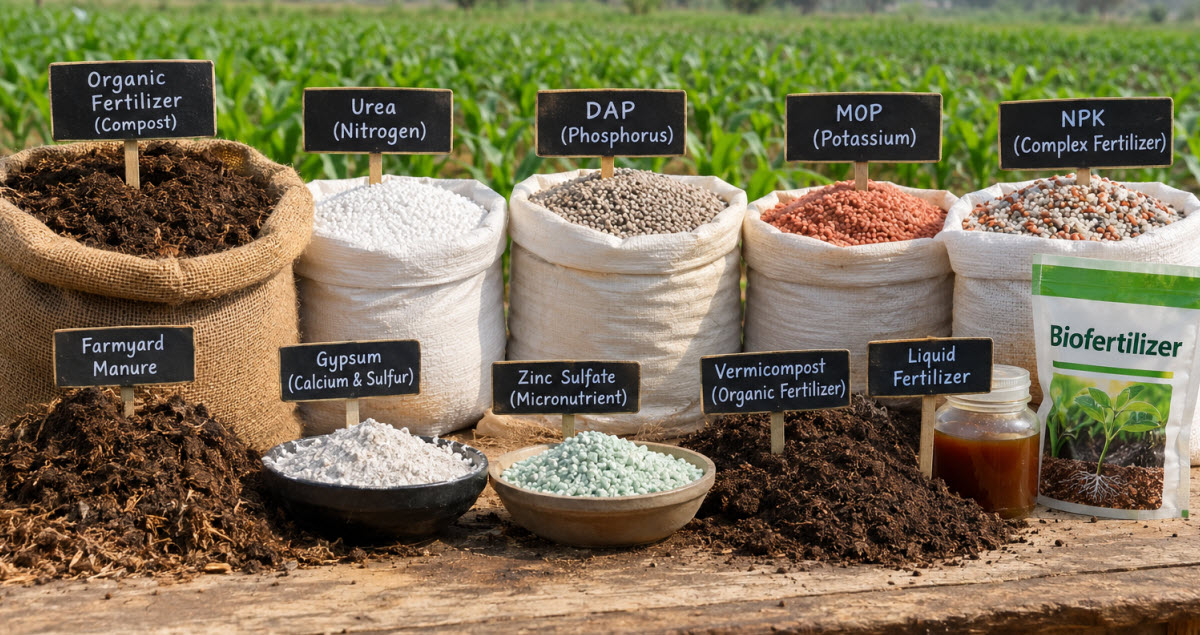
Healthy crops need the right nutrients at the right time. When plants do not get enough nutrients from the soil, their growth may slow down, leaves may turn yellow, and crop production may decrease. Fertilizers help farmers supply these essential nutrients and maintain healthy crop growth. Different fertilizers serve different purposes. Some help plants develop green leaves, while others support root growth, flowering, fruit development, and grain formation. Choosing the right fertilizer depends on the crop, soil condition, weather, and stage of plant growth. In this article, we will explain the different types of fertilizers, their uses, common examples, and how farmers can choose the right fertilizer for their crops. What Are Fertilizers? Fertilizers are materials added to soil or plants to supply nutrients needed for healthy growth. These nutrients help plants produce leaves, develop roots, form flowers, and produce fruits or grains. Plants need several nutrients throughout their growing period. The three main nutrients supplied through fertilizers are: Nitrogen (N): Helps plants develop green leaves and healthy vegetative growth. Phosphorus (P): Supports root development, early plant growth, and seed formation. Potassium (K): Helps regulate water movement, supports plant health, and contributes to crop quality. Plants also need calcium, magnesium, sulfur, iron, zinc, boron, and other nutrients in different amounts. A shortage of any essential nutrient...

Use of Biodegradable Nanoclay Polymer Composite (NCPC) for controlled release of nitrogen fertilizer in soil पौधों के विकास के लिए सबसे महत्वपूर्ण तत्व नाइट्रोजन है जिसकी आवयश्कता बड़ी मात्रा में होती है अतः  कमी से बचने के लिए इसे उर्वरक के द्वारा मिट्टी में डालना अति आवश्यक है। वर्त्तमान समय में, किसानों द्वारा अंधाधुन उर्वरकों का  प्रयोग उत्पादन सीमा में वृद्धि के लिए किया जा रहा है। दक्षिण पूर्व एशिया में यूरिया सबसे अधिक उपयोग की जाने वाली उर्वरकों की श्रेणी में है इसका एक कारण इसमें मौजूद उच्च नाइट्रोजन की मात्रा और दूसरा इसके उत्पादन में अपेक्षाकृत कम लागत का होना है। हालांकि, पारम्परिक  उर्वरकों से नाइट्रोजन  का लगभग 40-70% पर्यावरण में  नष्ट हो  जाता है, जो भारी आर्थिक और संसाधन हानि के साथ-साथ गंभीर  पर्यावरण प्रदूषण का भी कारण है। इन अपर्याप्तताओं की भरपाई, ऐसे उर्वरक जो नियंत्रित गति से मृदा में पोषक तत्त्व छोडते है, से की जा सकती है। ऐसे उर्वरकों को स्लो रिलीज़ फ़र्टिलाइज़र कहते है। स्लो रिलीज़ फ़र्टिलाइज़र उर्वरकों की दक्षता में भी बढ़ोतरी लाते है। ये पौधों की आवश्यकता अनुरूप पोषक तत्त्व स्त्रावित करते है एवं उर्वरकों को नष्ट होने से भी बचाते है। चूँकि पानी को कृषि के उत्पादन को सीमित करने वाले मुख्य कारकों में से एक माना जाता है, इसलिए जल संसाधन का उपयोग भी...

सटीक नाइट्रोजन उर्वरक प्रबंधन के लिए आधुनिक उपकरण और तकनीक Food production is commensurate with fertilizer usage. Among the three major fertilizers, nitrogen, phosphate and potassium, application of nitrogenous fertilizers is the maximum. It is reported that China, India and Pakistan together consume approximately 70% of nitrogen fertilizer consumed globally. These figures of nitrogen fertilizer consumption point towards emerging environmental pollution issues. The estimated food production demands would require application of N fertilizer to the tune of 116.0 million tonnes in 2016 and 58% of it would be required in Asia alone of which India’s share would be 30% (FAO Report, 2012). The consumption of N fertilizer in form of urea has increased many folds after green revolution in India which is mainly due to lacunae in soil testing facilities for a large number of small-holder marginal farmers which are mostly unaware about modern tools and techniques. The only guiding tool for the farmers is their own wisdom while applying urea and other pesticides and inputs. Often they end up following wrong package of practices as they have no scientific tools to measure what the soil is deficient in. India imported about 10.24 million tonnes (about 41% of total consumption) of fertilizer nutrient NPK in 2008-09 as against 1.93 million tonnes in 2002-03.India produces 10% of world...

मिट्टी में उर्वरकों का प्रबंधन The fertilizers are becoming costly input day by day. Hence it is felt necessary to study the efficient use of this input. So some important points are given here to increase fertilizer use efficiency and to get higher yield. 1. Management of Nitrogen fertilizers in soil Nitrogen is lost from fertilizers by ways as follows: Volatilization Ammonia volatilization is an economic loss to the farmer in terms of both drained fertilizer prices and decreased crop yields. Some important facts are as follows: The ammonia volatilizing capacities of the fertilizers are graded as urea > ammonium sulphate > ammonium chloride > ammonium nitrate. The ammonia volatilizing capacities of the soils are graded as calcareous soil > alkaline soil > neutral soil > acid soil. In neutral and acid soils, ammonia volatilization occurs from urea only, not from other ammonium fertilizer viz. ammonium sulphate, ammonium chloride, ammonium nitrate. Surface application of fertilizers increases ammonia volatilization. Ammonia volatilization from urea added to the surface of warm and moist alkaline or calcareous soils can be completed within a week. To reduce volatilization loss of nitrogen, few recommendations are enlisted hereunder. Immediately after application (within a few hours), urea must be incorporated with soil by tillage or washed into the soil. Urea should never be left on the soil surface without incorporation.  In...