
28 Nov Dairy Farming in India: Cost, Breeds and Profit
Dairy farming is one of the most practical ways to build a regular source of income in rural India. It allows farmers to earn from milk sales while making use of agricultural land, crop residues and family labour. However, running a successful dairy farm involves much more than buying a few cows or buffaloes and selling their milk.
The real challenge is managing feed costs, selecting healthy animals, maintaining milk production and finding a reliable market. A farm may sell a good quantity of milk every day and still earn very little if expenses are not controlled.
For anyone planning to start a dairy farming business in India, understanding the initial investment, suitable dairy breeds, daily expenses and expected profit is essential. Farmers can also explore our guide to animal feed management to understand why feeding practices matter. This guide explains these factors with practical examples to help farmers make informed decisions.
What Is Dairy Farming?
Dairy farming is the business of raising cows or buffaloes for milk production and selling milk or dairy products. Depending on the farm’s size and resources, it may also involve breeding animals, raising calves, producing fodder and selling manure.
In India, dairy farming is practised by small farmers, agricultural families, self-help groups and commercial dairy businesses. Many farmers begin with one or two animals and expand gradually as their experience and customer base grow.
India’s dairy sector also plays an important role in rural livelihoods and nutrition. According to the Government of India’s Department of Animal Husbandry and Dairying, India is the world’s largest milk producer, contributing approximately 25% of global milk production. Source: Department of Animal Husbandry and Dairying.
The opportunity is significant, but profitability depends on local milk prices, animal productivity, feed availability and the farmer’s ability to manage daily operations.
Is Dairy Farming Profitable in India?
Yes, dairy farming can be profitable when the farm is properly managed. However, profit is not guaranteed, and the results can differ considerably between farms.
A farmer with access to affordable green fodder, good-quality animals and a dependable milk buyer may earn better returns than someone who purchases all feed and sells milk at a lower price.
Before starting, consider these important factors:
- Milk production: How much saleable milk does each animal produce?
- Milk selling price: Does the farmer sell to a cooperative, private dairy, retailer or directly to customers?
- Feed expenses: How much does it cost to feed each animal every day?
- Animal health: Are veterinary care, vaccination and breeding services available nearby?
- Labour: Can the family manage daily work, or will paid workers be required?
- Milk demand: Is there a dependable market for the quantity the farm plans to produce?
One common mistake is calculating profit using the animal’s highest daily milk yield. A cow does not produce the same quantity of milk throughout the year. Milk production changes during lactation, and the animal also requires a dry period before the next calving.
A realistic business plan must account for these changes rather than assuming that peak milk production continues every day.
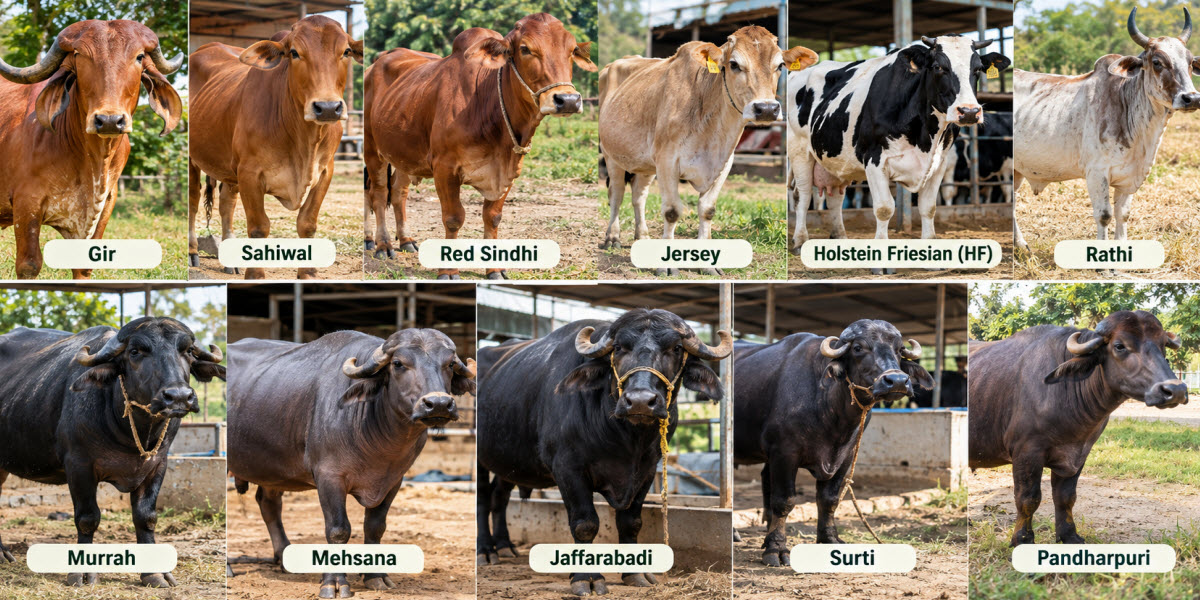
Best Dairy Cow and Buffalo Breeds in India
Choosing the right breed is one of the most important decisions when establishing a dairy farm. The best animal is not necessarily the one with the highest advertised milk yield. It is the one that suits the local climate, feeding resources, available veterinary care and milk market.
India has a diverse range of indigenous cattle and buffalo breeds adapted to different farming conditions. The National Dairy Development Board (NDDB) provides information about recognised breeds and their characteristics.
Popular Dairy Cow Breeds
| Breed | Main characteristics | Suitable for |
|---|---|---|
| Gir | Indigenous breed known for milk production and adaptability | Farmers interested in indigenous cattle |
| Sahiwal | Established dairy breed with heat tolerance | Dairy farming in warm regions |
| Red Sindhi | Indigenous breed known for adaptability | Small and medium dairy farms |
| Jersey crossbred | Often valued for milk production and adaptability | Farms with good feeding and management |
| Holstein Friesian (HF) crossbred | Potential for relatively high milk production | Farms with strong feeding, housing and veterinary management |
| Rathi | Indigenous breed associated with Rajasthan | Farmers in suitable dry and semi-arid regions |
These breeds have different production characteristics, and actual performance varies between individual animals. Crossbred cows can have higher feed and management requirements, so farmers should assess their suitability before purchasing.
Popular Buffalo Breeds
| Breed | Main characteristics | Suitable for |
|---|---|---|
| Murrah | Widely recognised dairy buffalo breed | Commercial milk production |
| Mehsana | Dairy buffalo breed associated with Gujarat | Small and commercial dairy farms |
| Jaffarabadi | Large buffalo breed known for its dairy potential | Farms with suitable space and feed |
| Surti | Buffalo breed associated with Gujarat | Farmers interested in buffalo milk |
| Pandharpuri | Indigenous buffalo breed associated with Maharashtra | Dairy farming in suitable local conditions |
Buffalo milk generally has a higher fat content than cow milk, which can make buffaloes attractive where buyers pay according to fat percentage or where milk is sold for products such as ghee and khoa.
However, a higher selling price does not automatically mean higher profit. Buffaloes may also involve different purchase costs, feed requirements and production patterns.
Important: Before buying any animal, check its actual milk yield, age, number of calvings, pregnancy status and health history. Whenever possible, observe the animal during milking and verify its performance with the seller’s records. A local veterinarian should examine the animal before purchase.
For recognised breed information, refer to the NDDB breed directory.
How Much Does It Cost to Start a Dairy Farm in India?
The initial investment depends on the number of animals, their quality, shed construction, equipment and the availability of land and fodder.
A small farm using an existing shed may require substantially less capital than a new commercial unit that needs construction, water facilities, equipment and hired workers.
The following table provides illustrative planning estimates. These are not fixed market rates or official quotations. Actual costs depend on the location, breed, animal’s milk yield and construction requirements.
| Expense | Estimated cost for a small farm |
|---|---|
| Purchase of 2 dairy animals | ₹1,20,000–₹2,00,000 |
| Basic shed and drainage | ₹40,000–₹1,00,000 |
| Feeders, buckets and basic equipment | ₹10,000–₹25,000 |
| Water and electricity arrangements | ₹5,000–₹20,000 |
| Initial veterinary checks and transport | ₹5,000–₹15,000 |
| Initial working capital | ₹25,000–₹45,000 |
| Estimated total | ₹2,05,000–₹4,05,000 |
The above estimate assumes a basic setup and excludes land purchase, major machinery and some possible additional expenses. If a suitable shed and water supply already exist, the investment may be lower.
For a more detailed financial reference, NABARD publishes dairy farming unit costs. Its 2025–26 unit-cost document, for example, lists a financial outlay of ₹1,97,840 for a two-animal crossbred Holstein Friesian unit under its stated assumptions. The document includes animals, equipment, a limited amount of working capital and insurance-related costs. Shed construction and other requirements may add to the total. Source: NABARD unit costs.
Estimated Investment by Farm Size
The following figures are broad planning ranges rather than standard bank-approved project costs.
| Farm size | Approximate initial investment |
|---|---|
| 2 animals | ₹2 lakh–₹4 lakh |
| 5 animals | ₹5 lakh–₹9 lakh |
| 10 animals | ₹9 lakh–₹16 lakh |
| 20 animals | ₹18 lakh–₹32 lakh |
Larger farms may benefit from economies of scale in equipment and labour, but they also require more fodder, water, working capital and market access.
Do not spend the entire budget on purchasing animals. Keep sufficient money available for feed, veterinary expenses and other operating costs until milk sales become regular.
Daily Feed Requirements and Feeding Costs
Feed is usually the largest recurring expense in dairy farming. The National Dairy Development Board explains that feeding can account for around 70% of dairying expenses in some production systems, making feed management central to profitability. Source: NDDB Animal Nutrition.
A balanced ration generally includes green fodder, dry fodder, concentrate feed, minerals and clean drinking water. The correct quantities depend on the animal’s body weight, milk yield, pregnancy status and the nutritional quality of available fodder.
Main Types of Dairy Animal Feed
1. Green fodder
Green fodder provides moisture, fibre and nutrients. Depending on the region and season, farmers may use maize, sorghum, hybrid napier, fodder cowpea and other suitable fodder crops.
Growing fodder on the farm can reduce purchased-feed expenses, provided the farmer has enough land, water and labour. Read more about Azolla farming as a supplementary green fodder option.
2. Dry fodder
Dry fodder such as wheat straw, paddy straw and suitable hay supplies fibre. Its nutritional value varies, so it should form part of a balanced ration rather than being the only feed.
3. Concentrate feed
Concentrates provide energy and protein needed for milk production. The quantity should be adjusted according to the animal’s nutritional requirements and milk yield.
Feeding excessive concentrate can increase costs and may create health problems. A locally prepared balanced ration is generally more useful than following a fixed quantity for every animal.
4. Mineral mixture and salt
Minerals are important for animal health, reproduction and milk production. Farmers should use an appropriate mineral mixture according to veterinary or animal nutrition advice.
5. Clean drinking water
Dairy animals need continuous access to clean water. Water requirements vary with temperature, body size, feed and milk production. Insufficient water can reduce feed intake and milk yield.
How Much Does Feed Cost Per Animal?
For preliminary budgeting, a farmer might allow approximately ₹150–₹300 per day per adult dairy animal for green fodder, dry fodder and concentrate feed combined. This is an illustrative range, not a universal feeding cost.
The actual amount can be lower when fodder is grown economically and higher when purchased feed is expensive or the animal has high nutritional requirements.
Farmers should calculate feed costs using local prices rather than relying on a national average.
For guidance on balancing feed, see the NDDB Ration Balancing Programme. You can also read KrishiSewa’s article on seasonal animal feed management.
Dairy Farm Profit Calculation: A Practical Example
Let’s consider a small dairy farm with two crossbred cows.
For this example, assume both cows are currently producing milk. The calculation uses average saleable milk, not the animals’ highest possible yield.
Monthly Milk Income
| Particulars | Calculation | Amount |
|---|---|---|
| Average milk sold per cow per day | 10 litres | – |
| Milk from two cows per day | 10 × 2 | 20 litres |
| Milk selling price | Assumed ₹40 per litre | – |
| Daily milk revenue | 20 × ₹40 | ₹800 |
| Monthly milk revenue | ₹800 × 30 days | ₹24,000 |
This is gross revenue, not profit. The ₹40 selling price is an example only; actual prices vary by state, milk quality, fat content and buyer.
Monthly Operating Expenses
| Expense | Estimated monthly cost |
|---|---|
| Feed and fodder for two cows | ₹12,000 |
| Veterinary care, medicines and breeding reserve | ₹1,000 |
| Water and electricity | ₹500 |
| Transport and miscellaneous expenses | ₹1,000 |
| Total estimated operating expenses | ₹14,500 |
Under these assumptions:
Monthly operating surplus = ₹24,000 − ₹14,500 = ₹9,500.
This amount is before accounting for paid labour, loan interest and repayments, depreciation, shed maintenance, insurance, and the economic cost of family labour and land.
It also assumes both animals maintain the stated milk production throughout the calculation period, which will not be true throughout a full year.
What Happens When Milk Production Changes?
The following comparison uses the same assumed selling price of ₹40 per litre and operating expenses of ₹14,500 per month for illustration.
| Average milk per cow per day | Monthly gross revenue | Surplus before additional costs |
|---|---|---|
| 6 litres | ₹14,400 | -₹100 |
| 8 litres | ₹19,200 | ₹4,700 |
| 10 litres | ₹24,000 | ₹9,500 |
| 12 litres | ₹28,800 | ₹14,300 |
This comparison holds monthly expenses constant to show the effect of milk production alone. In reality, feed expenses may change as production changes, and milk yield can decline during lactation.
The table illustrates an important point: a small change in milk yield can have a significant effect on the farm’s financial performance.
How to Calculate Profit More Accurately
For a proper dairy business plan, calculate the average milk produced and sold over the entire year, including periods when animals are dry or producing less milk.
Use this basic formula:
Net operating profit = Total milk and other farm revenue − Total operating expenses.
Include all relevant expenses:
- Green fodder, dry fodder and concentrate feed
- Mineral mixture and supplements
- Labour, including the value of family labour
- Veterinary care, medicines, breeding and insurance
- Electricity, water, transport and milk collection
- Shed maintenance and equipment depreciation
- Interest on borrowed capital
Loan principal repayments should also be included when assessing cash flow, even though they are not treated as an operating expense in the same way as interest.
Manure, calves and other farm outputs may provide additional income, but only count revenue that the farm can realistically earn.
Dairy Farming Business Plan for Beginners
A successful dairy farm begins with planning, not purchasing animals.
Step 1: Study the Local Milk Market
Find out who will buy your milk before investing in the farm. Contact nearby dairy cooperatives, private milk collection centres, sweet shops, hotels or direct customers.
Ask about the current purchase price, fat and solids-not-fat testing, collection timings, payment schedule and quality requirements.
Direct selling may offer a higher price, but it also requires customer management, delivery and reliable milk handling.
Step 2: Select the Right Animals
Start with animals that suit your budget, climate, available feed and level of experience.
Purchase from a reliable breeder or dairy farm. Check milk records, udder condition, age, previous calvings and health history. Avoid buying solely on the seller’s verbal promise of high milk production.
A veterinarian should check the animal for relevant diseases and reproductive or other health concerns before purchase.
Step 3: Prepare the Shed
The shed should provide good drainage, ventilation, shade and enough space for feeding, resting and movement.
The floor should be non-slip and easy to clean. Provide clean drinking water, appropriate manure storage and a safe arrangement for handling animals.
In hot regions, shade, airflow and measures to reduce heat stress are particularly important because heat stress can affect feed intake, fertility and milk production.
Step 4: Arrange Fodder Before the Animals Arrive
Feed expenses can quickly become a problem if the farm depends entirely on purchased fodder.
If land is available, plan seasonal fodder production. Identify dependable suppliers for dry fodder and concentrate feed, and keep a reserve for periods when green fodder is scarce. For another fodder idea, see mulberry cultivation as a fodder crop.
Do not increase milk production targets without checking whether the farm can provide the required nutrition economically.
Step 5: Maintain Daily Records
Keep a simple register for each animal. Record:
- Daily milk production and quantity sold
- Feed quantities and costs
- Milk payments received
- Veterinary treatments and vaccinations
- Breeding dates, pregnancy checks and calving
- Dry periods and major health events
These records help identify animals with poor productivity and expenses that are reducing profit. They also make it easier to prepare a project report when approaching a bank.
Step 6: Expand Gradually
Once the farm has stable milk sales, reliable feeding arrangements and positive cash flow, consider adding more animals.
Expansion should depend on actual performance, not expected income alone. More animals mean greater requirements for fodder, labour, housing, veterinary care and milk marketing.
Dairy Cow or Buffalo: Which Is Better for Business?
Both cows and buffaloes can support a profitable dairy business. The right choice depends on local demand and production costs.
| Factor | Cow dairy farming | Buffalo dairy farming |
|---|---|---|
| Milk market | Suitable for markets buying cow milk | Attractive where higher-fat milk earns a premium |
| Breed selection | Indigenous and crossbred options | Several established dairy buffalo breeds |
| Feed management | Depends on breed, yield and body size | Depends on breed, yield and body size |
| Purchase cost | Varies widely | Varies widely |
| Profit potential | Depends on yield, price and expenses | Depends on yield, price and expenses |
Do not assume that buffaloes always generate higher profits because their milk may sell at a higher price. Likewise, a high-yielding crossbred cow may not be the most economical choice if purchased feed is expensive or local conditions make management difficult.
Compare the expected revenue and full cost per litre before choosing.
Common Dairy Farming Mistakes to Avoid
Many dairy businesses struggle because of avoidable management problems rather than a lack of demand for milk.
Buying animals without checking milk yield: An animal may produce less milk than expected after changing farms or during a different stage of lactation. Verify performance before purchase.
Ignoring feed costs: Spending too much on concentrate feed without improving the balance of the ration can reduce profit. Review feed quality and costs regularly.
Keeping all animals at the same lactation stage: If several animals become dry at the same time, milk sales may fall sharply. Plan breeding and calving schedules carefully.
Delaying veterinary treatment: Delayed diagnosis can increase treatment costs, reduce production and affect animal welfare.
Depending on a single buyer: Understand the buyer’s payment terms and consider alternative outlets if the main buyer stops collecting milk or reduces the price.
Expanding with borrowed money too quickly: Loan repayments continue even when milk production falls. Prepare a cash-flow plan that accounts for low-production periods and unexpected expenses.
Ignoring hygiene: Dirty equipment, contaminated water and poor milk handling can affect quality and customer trust. Maintain proper cleaning and milk storage practices.
Government Schemes and Dairy Farm Loans
Farmers may explore bank finance and eligible livestock development programmes to establish or improve a dairy business. However, the availability of financial support depends on the scheme, state, applicant category, project and current guidelines.
Before applying, contact your bank branch, district animal husbandry office or the relevant state dairy development department.
Ask about:
- Dairy farm term loans for eligible animals, sheds and equipment
- Working capital support for feed and other recurring expenses
- Kisan Credit Card facilities for eligible animal husbandry activities
- Applicable state-level dairy development or livestock support programmes
- Training and veterinary services available in your district
NABARD’s published unit costs can help with preliminary project planning, but they do not guarantee loan approval or subsidy eligibility.
Be careful with websites that promise a fixed dairy farming subsidy to every applicant. Check whether the scheme is currently active and whether your proposed project qualifies before making financial commitments.
How to Increase Profit from Dairy Farming
Improving profitability does not always require buying more animals. Often, the better approach is to reduce avoidable costs and improve the performance of the existing herd.
Grow suitable green fodder: Where land and water are available, fodder cultivation can help control feed costs.
Balance the ration: Feed according to the animal’s requirements instead of using the same quantity for every cow or buffalo.
Monitor production per animal: Compare daily milk output with feed costs and health records. This helps identify where management needs improvement.
Maintain animal health: Follow veterinary advice on vaccination, parasite control, breeding and disease prevention.
Plan breeding and calving: Proper reproductive management helps reduce unnecessary gaps between productive periods.
Improve milk marketing: Compare the net returns from cooperative sales, private collection centres and direct customer sales. Consider delivery costs, spoilage risk and time spent selling.
Use manure productively: Farmyard manure or properly managed compost can reduce fertiliser purchases or provide an additional source of revenue where a market exists.
Control avoidable waste: Reduce feed spoilage, improve water management and keep accurate records of purchases and sales.
Is Dairy Farming Suitable for Small Farmers?
Dairy farming can be suitable for small farmers who have access to feed, water, veterinary services and a dependable milk market.
A small unit can also complement crop farming. Crop residues may be used as part of the feed ration where appropriate, and farm manure can be returned to agricultural fields. Farmers can learn more about improving soil fertility and crop productivity.
However, dairy farming requires daily attention. Animals need feeding, cleaning and health monitoring every day, including holidays and periods when milk production is low.
Farmers who depend entirely on hired labour or purchased fodder should calculate expenses carefully before starting.
For beginners, a small, manageable herd is often a better way to learn animal care, milk marketing and financial management before making a larger investment. For more farming resources, visit the KrishiSewa agriculture information portal.
Frequently Asked Questions About Dairy Farming in India
1. How much money is required to start a dairy farm in India?
A basic two-animal dairy unit may require around ₹2 lakh–₹4 lakh under the illustrative assumptions in this guide. The actual cost depends on animal prices, shed requirements, equipment, local feed costs and working capital. Land purchase and major machinery would increase the investment.
2. How many cows are needed to earn ₹50,000 per month?
There is no fixed number because milk yield, selling price, feed expenses, labour and dry periods vary. Calculate the expected annual profit per animal first, then estimate the herd size required. Do not treat gross milk sales as take-home income.
3. Which cow breed is best for dairy farming in India?
Gir, Sahiwal, Red Sindhi, Jersey crossbred and Holstein Friesian crossbred cattle may suit different farming conditions. The best choice depends on local climate, milk demand, feed availability, animal health and the farmer’s management capacity.
4. Is buffalo farming more profitable than cow farming?
Not necessarily. Buffalo milk may earn a higher price because of its fat content, but purchase costs, milk yield, feeding expenses and the local market determine the final result. Compare net returns rather than milk prices alone.
5. How much does it cost to feed one dairy cow per day?
For preliminary budgeting, an illustrative range is ₹150–₹300 per adult dairy animal per day. Actual expenses depend on milk production, ration quality, local feed prices and whether the farmer grows green fodder.
6. Can dairy farming be started without owning agricultural land?
Yes, it may be possible to operate a small dairy farm without owning agricultural land if suitable housing, a dependable fodder supply, water, veterinary care and a local milk market are available. Renting suitable land or purchasing fodder can increase operating expenses.
7. Does dairy farming require daily work?
Yes. Animals need daily feeding, clean water, housing maintenance, health monitoring and milking according to their management schedule. A reliable person must be available even when the owner is away.
8. Is dairy farming a good long-term business?
It can be a sustainable business when milk demand is reliable, animals are managed well, feeding costs are controlled and the farmer maintains enough working capital. Results should be reviewed regularly because milk prices, feed costs and animal productivity can change.
Final Thoughts
Dairy farming in India can provide a steady business opportunity, but success depends on practical decisions made before and after the animals arrive.
Choose breeds suited to your local conditions, prepare the shed, arrange fodder, identify a milk buyer and maintain a realistic budget. Most importantly, calculate profit after all relevant costs instead of judging the business by daily milk sales alone.
For beginners, starting small and learning to manage feeding, animal health and marketing can be more valuable than investing heavily in a large herd from the beginning.
A well-managed dairy farm grows through consistent care, accurate records and careful financial planning not simply by increasing the number of animals.

No Comments