
Agriculture Knowledge for Everyone

grape Tag

अंगूर की उत्पादकता में सुधार कैसे करें। Among all the horticultural crops, grapes have received a special importance in view of its value addition into raisins. Wine grape area is around 3000 ha and production is estimated about 30000 MT with a productivity of 10MT/ha and wine production is estimated at 15 million liters from this production. Major area in the country is spread in the states of Maharashtra (to the extent of 75 to 80 percent in Nasik, Sangli, Solapur, Satara, Pune and Latur districts) followed by Karnataka (Bijapur, Bangalore, Belgaum, Gulbarga, Raichur districts), Andhra Pradesh (Hyderabad and Ranga Reddy districts) and Tamil Nadu (Theni, Coimbatore and Madurai districts) and small parts in North India states (Punjab, Uttar Pradesh, Haryana, Himachal Pradesh, Jammu & Lashmir) and East and North East states (West Bengal and Mizoram). In India grape is grown from tropical, subtropical to temperate climate. The major problems faced in tropical region are, ever growing of vines without rest period (dormancy) which is contrary to the scenario in temperate regions. Due to continuous growth and the warm and humid climate, the incidence of insect pests and diseases is more and the requirement of inputs viz., pesticides, manures and fertilizers, growth regulators and labor is almost double as compared to temperate countries. Further,...
केनोपी की शुक्ष्म जलवायु का अंगूर और वाईन की गुणवत्ता पर प्रभाव Many of the earlier observations among several viticulture scientists all over the world indicated a strong effect of climate on both yield and quality of grapes. To fully understand these effects, we need to differentiate between three levels of the climate based on the ideas of the famous German climatologist, Geiger. Macroclimate (Regional climate): This is the climate of a particular region, and a weather stations located in that region usually describe the general pattern of the macroclimate. Mesoclimate (Site climate): The mesoclimate of a particular vineyard varies from macroclimate of region because of differences in elevation, slope, aspect or distance from moderating factors like lakes or oceans. Mesoclimate can be very important for success of vineyard especially where climatic factors are limiting. Microclimate (Canopy climate): It is the climate within and immediately surrounding the vine canopy. Measurement of climate shows differences between and within canopy values and those immediately above it. Microclimate differences can occur over a few centimeters also. Important microclimatic factors Some of the important microclimatic factors, which determine the grape quality, are temperature prevailing in the climate, sunlight (both quality and quantity), humidity, wind speed and evaporation. Although most of these factors major role in producing good quality grapes (for table purpose) and...

अंगूर का रस - स्वास्थ्य के लिए एक घूंट ले India is ranked 12th in the world in terms of grape production. About 78% of production in India is utilized as table purpose, 17-20% for raisin production and remain for juice and wine. Juicing is an excellent way to absorb the maximum nutritional content of fruits and vegetables. All the enzymes, water-soluble vitamins and minerals built-in in these foods are condensed into one glass of juice and, because of the deficiency of fiber; the vastly concentrated nutrients go straight into the bloodstream. Grapes are an excellent source of potassium, which encourages an alkaline blood balance and also stimulates the kidneys and regulates heartbeat. In addition to mineral elements of sodium, potassium calcium, phosphorous, iron, copper and manganese, grapes also contain biotin, niacin, inositol, pantothenic acid, pyridoxine hydrochloride, thiamine, folic acid, ascorbic acid, choline and trace amount of riboflavin and vitamin B12. The restorative power of grapes is phenomenal, cleansing the liver and removing the uric acid from the body. Grapes also contain a phytochemical that appears to protect each cell's DNA from damage. Studies have shown a lower incidence of cancer in the areas of France where this grape fast is practiced yearly. The flavour of grape juice is the result of a...

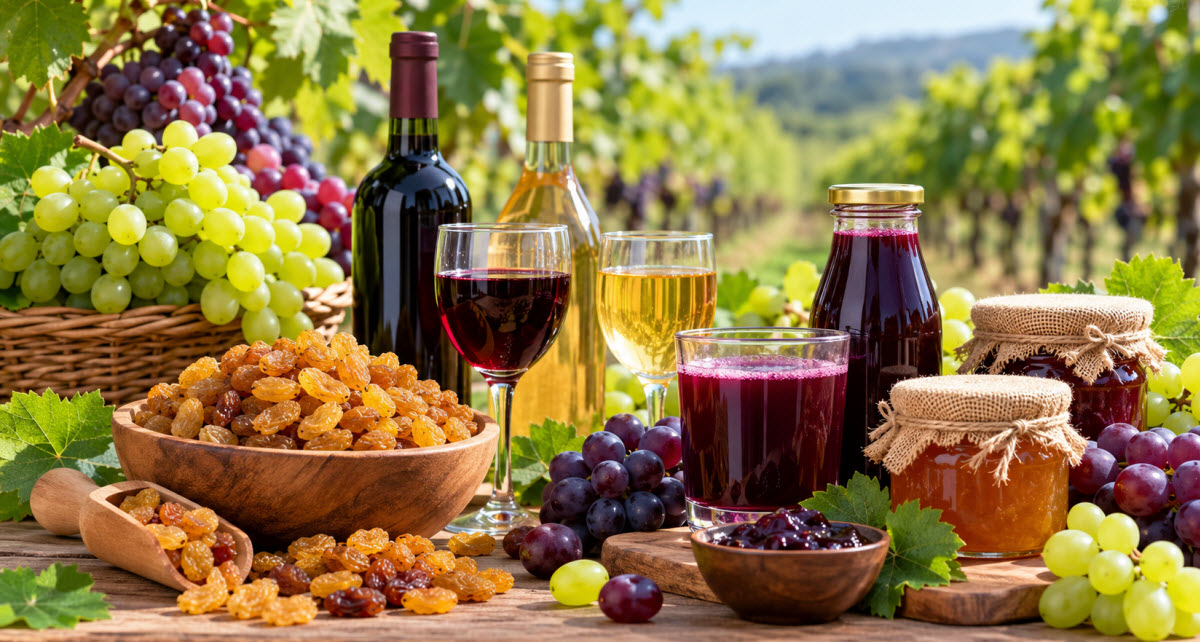
अंगूर में मुल्‍य सवर्धन कैसे करें तथा अगूंर के वि‍भि‍न्‍न उत्‍पाद क्‍या है। India ranks 11th in grape production with production of 1.8 million t grapes from an area of 80,000 ha. The major consumption of grapes in India is as fresh followed by raisins, wine and juice. While at global level 78-80% grapes processed in to wine followed by raisin, fresh grapes and juice. The value addition in grapes and diversification of grape products also provide good returns to growers. The raisin industry is also gaining good results. A quantity of 105000 t raisins was produced during 2009. But, it is not possible without active involvement of food industry in value addition sector. Adding value to grapes may be as simple as creatively packaging the grapes. This might be washing and packaging the fruit for a ready-to-eat snack or placing the fruit in a decorative container either alone or with other fresh fruit as a “farm fresh gift basket.” A. Value added products 1. Raisins The dried grapes are known as raisins. The Thompson Seedless white and thin skinned grape variety has monopoly in the production of best quality raisins. At global level, about 90% of raisins produced by drying of Thompson Seedless and clones. In India, grape drying is performed under raisin...

अंगूर के बाग के खरपतवार तथा उनका नि‍यंत्रण कैसे करें  In India Grape (Vitis venifera L.) is the one of the most important horticultural crop. It is cultivated on an area of 1.11 lakh / ha. In India grape is grown from tropical, subtropical to temperate climate. Major grape growing state of India are Maharashtra, Karanataka, Andhrapradesh ,Tamil Nadu, Panjab, Uttar Pradesh and Harayana. Among them Maharashtra is  leading state in production and cultivation of grapes. In the total production of the grapes in India Maharashtra shares the 60% of total production. The average yield in Maharashtra is 12 ton/ha but still it have been chance for increase the average yield. Though, there are many factors responsible for production of quality yield, one of them is weeds growing in vineyard. The cultural practices in grape production required huge manpower as compared to other crops. Approximately, 25-30% of the production cost  (amount) are utilized for labour and chemicals are used for control on weeds in vineyard.         A weed may defined as ‘any plant growing where it is no wanted’ or ‘a plant out of place’ or an unwanted plant by and large, any plant species amidst cultivated plants belonging to other species and it causing economic and health hazards...